




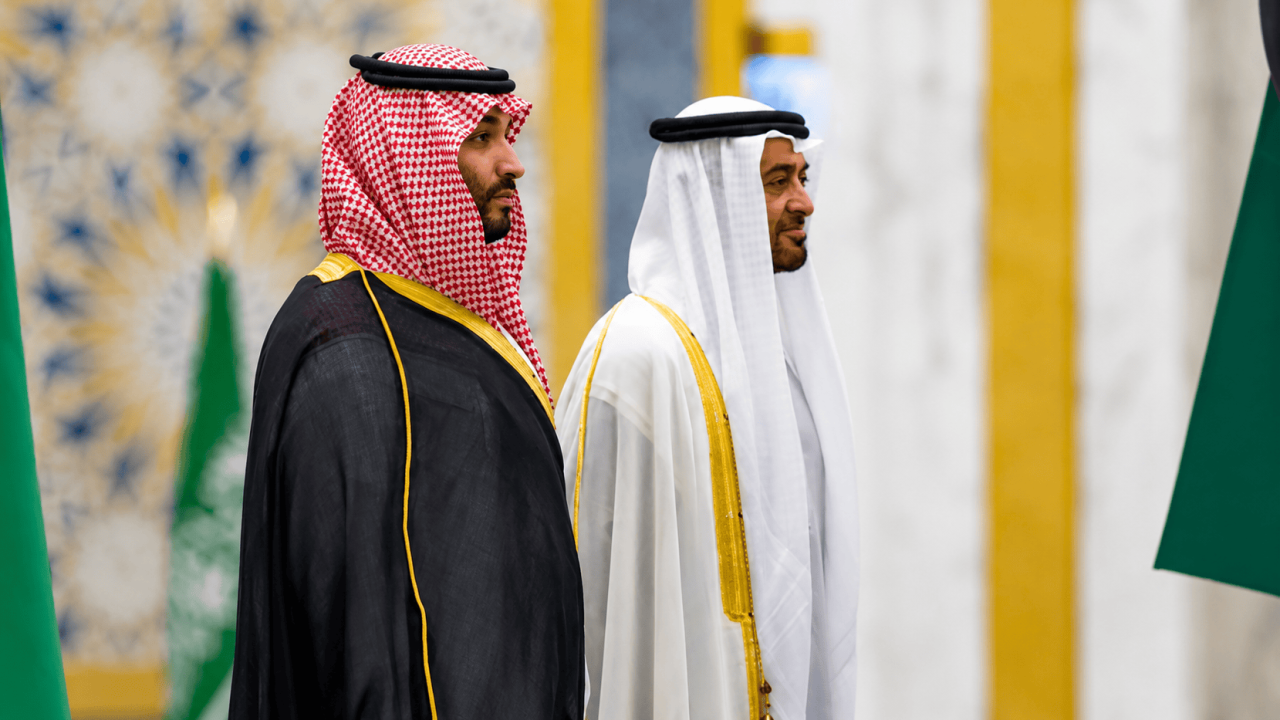
For much of the past decade, Saudi Arabia and the United Arab Emirates appeared to be among the Arab world's closest strategic partners. Together, they shaped regional policy, launched military campaigns, coordinated oil strategy, and sought to counter both Iranian influence and Islamist movements across the Middle East.
Fast forward to today, and the partnership that once defined Gulf politics now appears to be entering a messy breakup. Riyadh and Abu Dhabi are increasingly competing over regional influence, security priorities, and the future shape of the Middle East.
The growing divide between the Arab Gulf's two largest powers could fundamentally change the region's security architecture, from Yemen and Sudan to the Red Sea and beyond.
From Strategic Partners to Regional Rivals
The Saudi-UAE partnership was built on shared ambitions to modernize their economies, strengthen their militaries, and expand their influence across the Middle East.
Their unity was first tested in Yemen, when Riyadh and Abu Dhabi entered the conflict together and backed the internationally recognized government against the Iran-backed Houthi movement. Over time, the war exposed how different their goals were. Riyadh viewed a unified Yemen as vital to securing its southern border and supporting Vision 2030, while Abu Dhabi backed the Southern Transitional Council as a way to expand its influence over southern ports and key Red Sea shipping routes.
The divide became public in late 2025 when the Southern Transitional Council launched an offensive near the Saudi border. Riyadh supported a counteroffensive, transforming years of political disagreement into a proxy war and an increasingly open strategic rivalry.
Sudan, the Red Sea, and Competing Security Alliances
The growing Saudi-UAE rivalry has now spread beyond Yemen and into Sudan. The conflict in Sudan, which erupted in 2023, is a struggle between the Sudanese military and the Rapid Support Forces over control of the state, with the two Arab Gulf powers' supporting opposing sides.
The Red Sea has also become a strategic flashpoint. Saudi Arabia views secure maritime routes as vital to its national security and has grown increasingly concerned about expanding Emirati influence around the Bab al-Mandab Strait and Israel's growing regional presence.
The United Arab Emirates has deepened ties with Israel through the Abraham Accords, a series of agreements signed in 2020 that normalized diplomatic, economic, and security relations between Israel and several Arab states. While Riyadh has resisted closer relations with Tel Aviv, it has strengthened defense cooperation with Pakistan and expanded coordination with Turkey and Egypt on regional security.
Instead of a unified Arab Gulf strategy, competing alliances are beginning to emerge, reflecting the increasingly different regional visions of Riyadh and Abu Dhabi.
Energy Competition Further Weakens Arab Gulf Unity
The rivalry is also reshaping Arab Gulf energy politics. The United Arab Emirates's departure from OPEC ended nearly 60 years of coordinated oil policy and signaled Abu Dhabi's determination to pursue oil production without any quota limits. For Saudi Arabia, which has long relied on OPEC to stabilize markets and project regional leadership, the move is a very personal blow.
The US-Israel-Iran war also exposed the limits of the region's security architecture. As Saudi Arabia and the United Arab Emirates pursue competing regional strategies, Washington faces growing difficulty maintaining a unified Arab Gulf security framework.
Although the two countries remain close economic partners for now, their strategic priorities are diverging. If the rivalry deepens further, it could weaken Arab Gulf Cooperation Council unity and reshape the Middle East's balance of power for years to come.


Loading comments...