




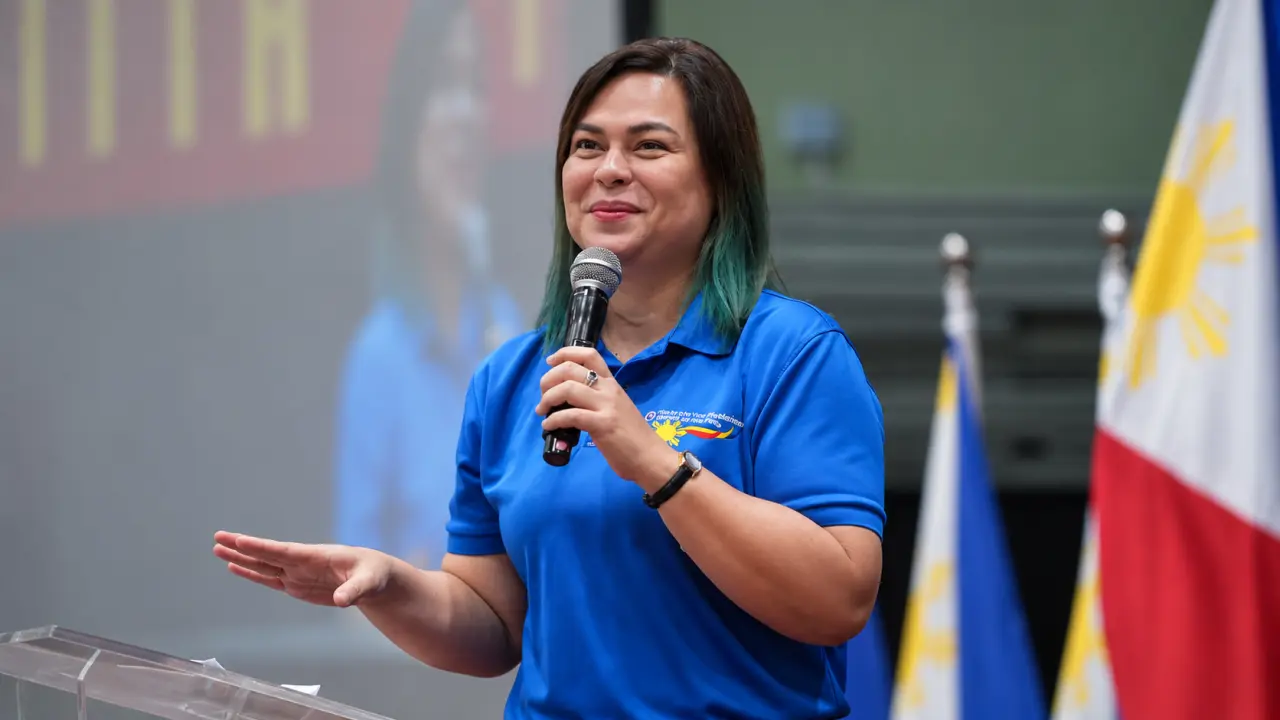
On November 8, amid growing Chinese pressure on the Philippines, Vice President Sara Duterte, who is currently facing impeachment, sparked controversy by urging Manila to avoid confronting China militarily over the West Philippine Sea (WPS). She made the remarks during a three-day visit to Hong Kong to meet with overseas Filipino workers (OFWs).
“How big is my gun? How big is the enemy’s gun?” Duterte asked, highlighting the military imbalance between the two countries. She proposed assembling a team of Filipino diplomats and negotiators and sending them to meet Chinese officials at whatever location Beijing preferred. She argued that the Philippines cannot provide enough jobs and that a breakdown in relations with Beijing could put many livelihoods at risk.
Her remarks triggered a wave of criticism from those who believe her position is anti-Philippines, downplays the Chinese threat, and weakens the defense of Philippine maritime rights. As one example, Philippine Coast Guard spokesperson Jay Tarriela accused Duterte of adopting a defeatist mindset and pointed out that Manila is already engaged in diplomatic talks with Beijing.
The Context Surrounding Duterte’s China Appeal
In Hong Kong, Sara Duterte tried to appeal to OFWs by warning that tensions with China could threaten their livelihoods. Oddly, she had nothing to say about Filipino fishermen back home whose livelihoods are already under threat from Chinese vessels in the West Philippine Sea.
In July, Chinese coast guard vessels fired water cannons at Philippine ships delivering fuel and supplies to fishermen near Scarborough Shoal. In September, another Chinese vessel rammed a Philippine fisheries ship carrying fuel assistance off Palawan.
In October, Philippine lawmakers demanded the expulsion of Chinese Ambassador Jing Quan after he mocked the Philippines and threatened that Beijing could easily defeat it by force.
Chinese state media also depicted Filipinos as monkeys in an AI-generated video mocking the Philippines' maritime claims. In response, Manila condemned the video as racist and lodged a formal diplomatic protest.
Absent from Duterte's speech was any acknowledgement of these instances of intimidation and humiliation directed at the Filipino people.
A Marcos Government Divided Over China
The disagreement over China extends beyond the Duterte-Marcos political rivalry. Tensions over how to handle Beijing are already simmering within the Marcos administration.
On November 3, Defense Secretary Gilberto Teodoro, who publicly rebuffed Beijing over a handwritten note in Seoul, rejected joint oil and gas exploration with China, arguing that it lacked a legal basis. That same day, Foreign Secretary Theresa Lazaro spoke with her Chinese counterpart, Wang Yi, about resuming energy negotiations and easing bilateral tensions.
The Department of Foreign Affairs subsequently warned that conflicting public statements by government officials could undermine the Philippines' credibility and weaken its negotiating position. It also reminded officials that foreign policy is directed by the president, not individual government members.
The controversy is particularly uncomfortable for Marcos, who just a month earlier denied any contradictions between his ministers and also defended the energy cooperation talks with China. The episode as a whole suggests that Marcos is struggling to maintain a unified position on China within his own administration.
When Diplomacy Failed to Prevent a Fait Accompli
The Philippines should know by now that easing tensions with China does not stop Beijing from expanding its maritime control. China has long used its naval superiority and gray-zone tactics to gradually alter the status quo while avoiding open military confrontation.
The most revealing precedent came in 2012, during the Scarborough Shoal crisis, known in the Philippines as Bajo de Masinloc. After a maritime standoff lasting more than two months, Manila withdrew its vessels in June amid diplomatic negotiations and approaching bad weather. China was expected to withdraw its vessels as well, but it did not. Instead, Chinese vessels remained at the shoal, allowing Beijing to establish de facto control over the area, which it continues to exercise today.
The lesson is that diplomacy alone cannot guarantee that China will stop its aggression, despite what Duterte claims. The bottom line is that China cannot be trusted, and any Filipino politician who says it can be probably should not be trusted either.
Loading comments...