




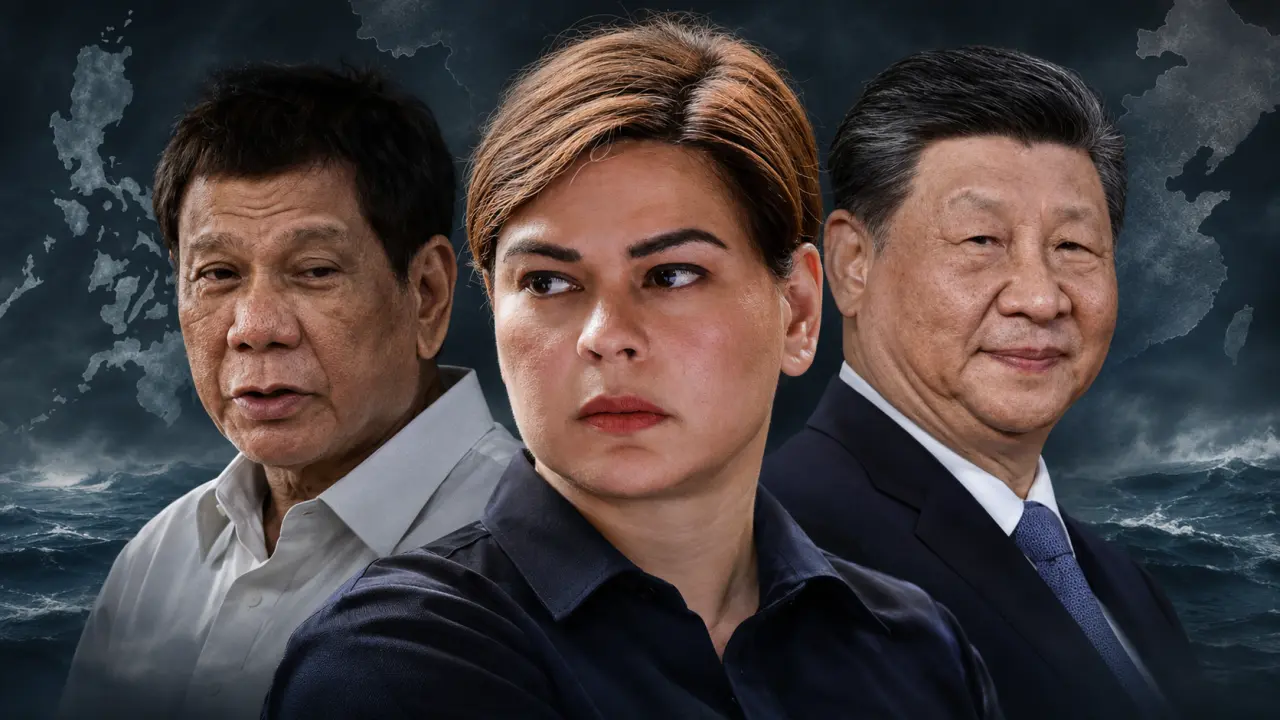
As Chinese vessels continue to harass Filipino fishermen in the West Philippine Sea (WPS), questions are growing over why Vice President Sara Duterte has remained largely silent on Beijing's aggression. On October 11, Leonardo Cuaresma, president of the New Masinloc Fishermen Association, publicly raised a disturbing possibility: had China bought Duterte's silence with millions of dollars?
The accusation came after revelations that Cale88 Foods, a company linked to Duterte's husband, Manases Carpio, had received $5 million from China and Hong Kong. The money has drawn additional scrutiny because of Duterte's oddly limited public criticism of China's actions in Philippine waters.
There is not yet any established evidence that the transfers were payment for political favors or that Sara Duterte personally received the money. Even still, the allegations raise serious questions about foreign influence at the highest levels of Philippine politics, particularly when the country is confronting an increasingly assertive China.
The $5 Million Now Under Investigation
During Sara Duterte's 2026 impeachment proceedings, the Anti-Money Laundering Council disclosed that Cale88 Foods had received $5 million from China and Hong Kong. Her husband, Manases Carpio, held shares in the company.
Three specific transactions were flagged as suspicious because they had no clear "economic purpose." Accusations also emerged that these suspicious transactions came from a Chinese state-owned company.
The revelations prompted the National Security Council to examine the remittances' potential implications for national security. The investigation has brought renewed attention to Beijing's efforts to cultivate political allies in the Philippines and concerns that Chinese money could be used to influence government decisions.
For her part, Sara Duterte has denied the allegations and calls them political persecution, saying that the existence of suspicious transfers does not prove that she or her husband acted on Beijing's behalf.
A Decade of Chinese Money and Duterte Ties
Questions about Chinese money and the Dutertes date back at least a decade. In March 2016, while running for president, Rodrigo Duterte acknowledged that an anonymous Chinese donor had paid for part of his election advertising. He never revealed the donor's identity.
Months after taking office, Duterte traveled to Beijing and declared that the Philippines was moving away from the United States, its longtime military ally.
The timing was particularly strange, coming just months after Manila secured a landmark arbitration ruling rejecting China's sweeping claims in the WPS. Rather than use the ruling to challenge Beijing, Duterte sidelined it and pursued closer ties with Xi Jinping. Beijing responded with promises of investment, loans, and military cooperation.
Chinese economic outreach also extended to Davao City, the Duterte family's political stronghold. AidData identified 26 Chinese-backed projects in the region worth $240 million. Over the years, some projects became the subject of allegations involving inflated costs and questionable financial practices.
While none of this proves that China bought the Dutertes, it does show that Beijing's relationship with the family goes deeper than just diplomacy. At a time when the Philippines is struggling to defend its interests in the WPS, any friendliness toward Beijing should be enough to cause concern.
China has spent years using pressure at sea and economic leverage to hurt the Philippines. Its coast guard routinely harasses Filipino vessels and targets fishermen. If China is willing to use those methods to get its way in the West Philippine Sea, why should Filipinos find it hard to believe that it might also try to buy influence among the politicians responsible for defending their country?
Loading comments...