




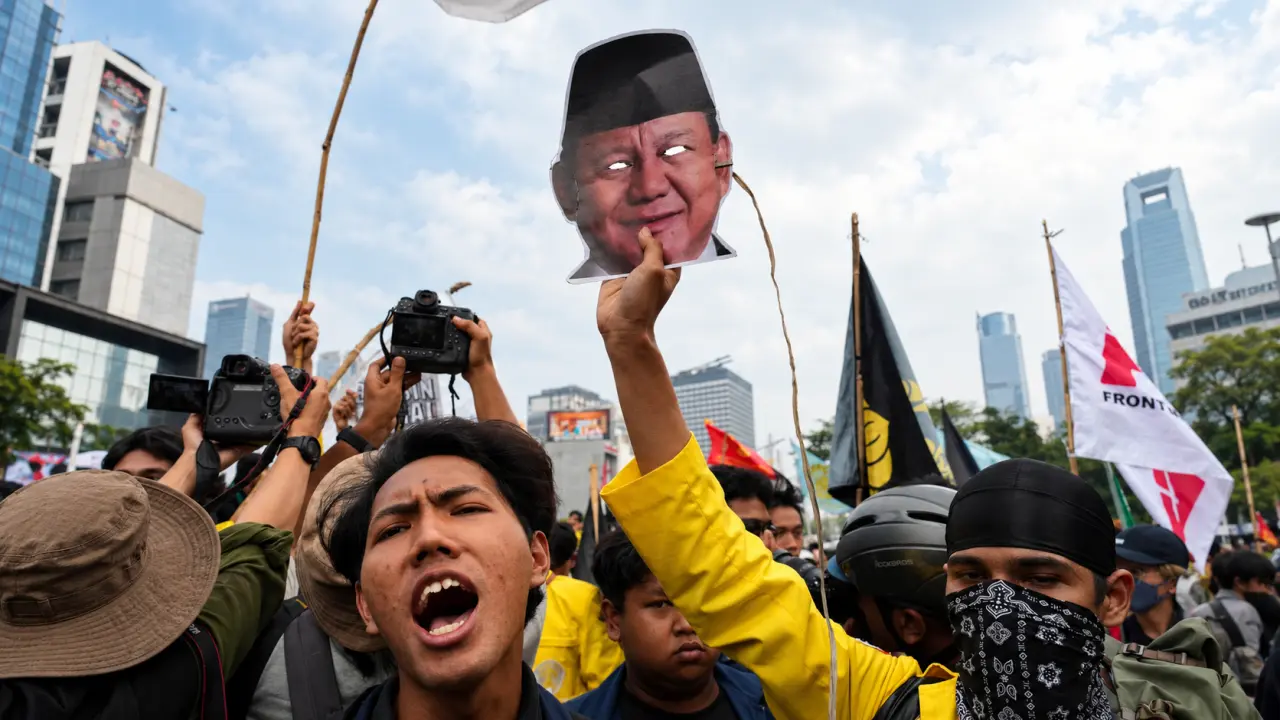
Prabowo Subianto governs Indonesia with the support of seven of the eight parties in Parliament. Yet his dominance of Indonesia's political institutions contrasts with growing public discontent.
Throughout October, thousands of students and civil society organizations took to the streets again in several cities to protest rising living costs, corruption, and the growing military presence in civilian affairs. In Jakarta, authorities responded with police blockades, tear gas, and water cannons.
Indonesia recorded 8,500 protests during Prabowo's first two years in office, nearly three times the number recorded during the equivalent period of his predecessor's second term. His approval rating fell from 81.2% in November 2025 to 44.5% in October 2026, according to polling firm SMRC.
Presidential Programs Create Cracks Within the Ruling Coalition
Students are challenging cuts to energy subsidies as rising prices strain household budgets. They are also criticizing Prabowo's multibillion-dollar free meals program, designed to feed millions of children and pregnant women, but plagued by logistical failures, corruption investigations, and at least 57,000 cases of food poisoning.
The political fallout is now reaching his own coalition. Reuters reported that leaders of two allied parties had decided to distance themselves from the program, while a third fears losing electoral support. Prabowo insists on keeping the program despite its problems, although he has promised improvements.
Adding to the situation, the worst forest fires in eleven years have swept the country, adding yet another grievance to the list. Protesters are demanding accountability from the companies involved and more resources to fight the fires, yet the Indonesian government continues to evade legal accountability over the disaster.
A Government Increasingly Reliant on Force
During the October 28 protests, police deployed some 14,000 officers in Jakarta, along with military personnel. Police blockades prevented students from advancing toward the Presidential Palace. Scuffles broke out, and as evening fell, protesters threw objects while security forces used tear gas and water cannons. Nineteen people were arrested.
The crackdown echoes earlier episodes of police violence. In 2025, the death of a motorcycle taxi driver who was run over by a police vehicle sparked nationwide protests. Authorities arrested more than 3,300 people at the time.
Jefferson Ng, a researcher at the ISEAS institute, describes Prabowo's approach to governance as "command politics": the president mobilizes military personnel and allies to implement decisions but restricts the mechanisms needed to identify and correct mistakes.
If Prabowo stays on this course, his government's failure to address the causes of public discontent risks further undermining public trust.
Loading comments...