




Every few months, Europe sends satellites into space from one of the poorest corners of the French Republic.
The rockets rise from Kourou, in French Guiana, a small territory on South America’s northern coast that France once used as a prison colony and now uses as a key space launch site. The business brings in money and strategic power, not for locals, but for Paris.
Outside the shiny, high-tech spaceport, life looks very different. French Guiana imports much of what it consumes, prices are high, and 53% of the population lives below the poverty line. Nearly 29% lives in extreme poverty.
These statistics capture the harsh reality that the territory has little control over the land and resources that could change its future. For activists advocating for French Guiana's independence, this is the core of the colonial trap. They say France cares about the territory's resources, but not about its people, their rights, or their political aspirations. France may no longer been an empire, but in French Guiana, Paris still acts like one.
A Colony Built to Serve Paris
France began building its colony in French Guiana in 1643, displacing indigenous communities inland and bringing enslaved Africans to work plantations. After slavery was abolished in 1848, many freed people left the plantations and built their own communities in the forest.
Just years later, Paris turned the territory into a giant prison. Between 1852 and 1953, around 80,000 people were sent to penal camps in French Guiana. About 70,000 died from hunger, disease, violence, or failed escape attempts. Even after the camps eventually closed in the aftermath of World War II, French Guiana remained poor and isolated.
France’s defeat in Algeria in 1962 gave the territory a new use. Charles de Gaulle, France's president from 1959 to 1969, had to move a French space testing site out of the Sahara, and French Guiana’s coast offered the right geography. It was close to the equator, where rockets get extra speed from the Earth’s rotation, saving fuel and carrying heavier cargo.
In 1964, France chose land near Kourou and Sinnamary for the new space center. About 105 families, roughly 650 people, already lived there. They were Indigenous and Afro-descendant families who had farmed the land for generations. They were moved by truck, given compensation, and placed in small concrete houses outside the base. They were forced to leave behind fields, farm animals and pets, and family members' graves. Some never again reached the cemetery where their relatives were buried.
Apparently Europe thought this was a small price to pay for a space launchpad. The first launch from Kourou came in 1970. Today, the spaceport serves France, its European neighbors, and commercial clients. It supports 41 companies and about 1,600 jobs. Despite this, few resources make their way to local communities.
A Territory Ruled Across the Atlantic
French Guiana has elections, local councils, and two deputies in France’s National Assembly. But most decisions still run through Paris. Key decisions on citizenship, justice, immigration, and constitutional status are controlled by the French state, while a prefect appointed by the French government oversees national interests in the territory.
This power imbalance is particularly visible in land ownership. Around 90% of the territory belongs to the French state, meaning that residents who want to access or develop it must get approval from the French government.
This matters because French Guiana is smaller than any sovereign country in South America, with around 90% of its surface covered by Amazon rainforest and most of its population concentrated along a narrow Atlantic coastal strip.
French Guiana is also far more diverse than the French label suggests. Indigenous peoples, Maroon communities descended from escaped slaves, Creoles, and families with roots in China, India, and Southeast Asia all form part of the territory's social fabric.
Independence advocates say Paris folds all of them into a French identity that denies the existence of a Guianese people with their own unique political aspirations. Modern calls for greater autonomy emerged in 1966, when the Union of Guianese Workers was founded and subsequently popularized the green-and-yellow flag with a red star that has become a symbol of Guianese identity.
A new generation of activists followed in the 1990s with the creation of the Movement for Decolonization and Social Emancipation, which pushed for greater local control over land, education, economic policy, and natural resources.
France’s Colonial Mindset Is Being Exposed
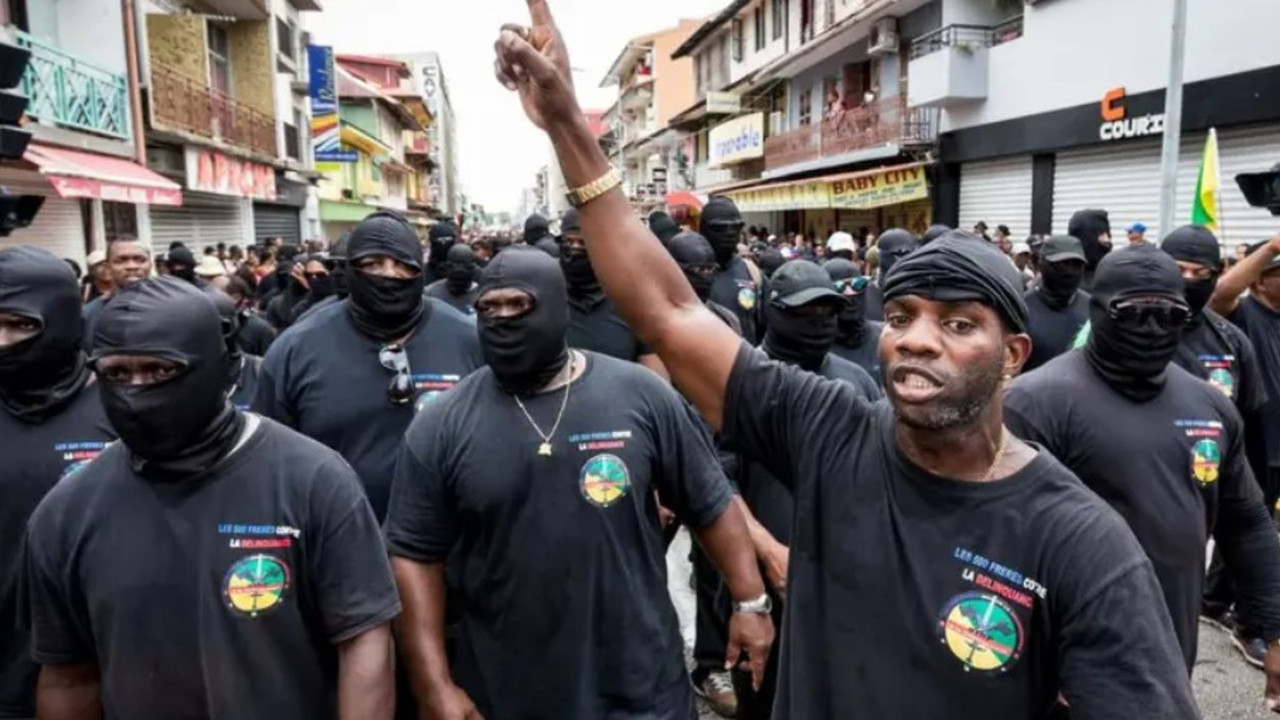
For decades, French Guiana's have taken to the streets to protest their situation. Time and time again, a pattern emerges where France responds to a crisis and makes promises to change, but ultimately does nothing to empower French Guianans to decide their own future.
In 1996, students protested poor schools and lessons they said came packaged from France, with little connection to local life. Unions and independence activists joined. Paris sent ministers and promised a local education authority and school funding. While some small changes occurred, nothing major changed.
In 2017, the territory erupted again over violence, poverty, and the cost of living. A general strike paralyzed French Guiana for 25 days. More than 40,000 people mobilized in Cayenne, with thousands more in the interior. Protesters surrounded the Kourou space base and forced rocket launches to stop. Schools closed. The prefecture was blocked.
Paris sent officials to negotiate, apologized for years of underinvestment, and promised €1 billion for security, health care, justice, and local economic measures. Yet again, however, the pattern was familiar: France offered money to the territory, yet did nothing to hand over power to the territory and give it more autonomy.
Notably, these particular protests did managed to foment some political changes. By 2022, French Guiana had sent independence supporters to France’s National Assembly. They had limited power in Paris, yet had nonetheless gained a national platform to challenge French control.
Economics May Determine French Guiana's Future
Next door to French Guiana, Guyana and Suriname are being reshaped by offshore oil discoveries. French Guiana has the same economic potential, but French law bans oil exploitation in its overseas territories. This makes it particularly ironic that French energy giant TotalEnergies is preparing to extract oil in Suriname.
French companies can profit from oil across the border, while French Guiana remains barred from using the resources that could make it stronger. For independence advocates, this contrast perfectly illustrates how Paris has always used French Guiana for its own needs, but prevented the territory from building its own economic strength.
These economic realities have added a new dimension to French Guiana's fight for independence. It is no longer asking only for recognition or a better place inside the French Republic. Instead, its leaders are challenging the economic order that keeps the territory dependent on France and preventing it to use the resources that Paris gets rich off.
For Paris, the issue is no longer just political disagreement. The bigger concern is that French Guiana could show a different path of development—one where it no longer depends so heavily on mainland France. If the territory were able to build a more self-sufficient economy, it would challenge the long-standing assumption that France’s overseas territories need to remain closely tied to the French state to function.
Loading comments...