




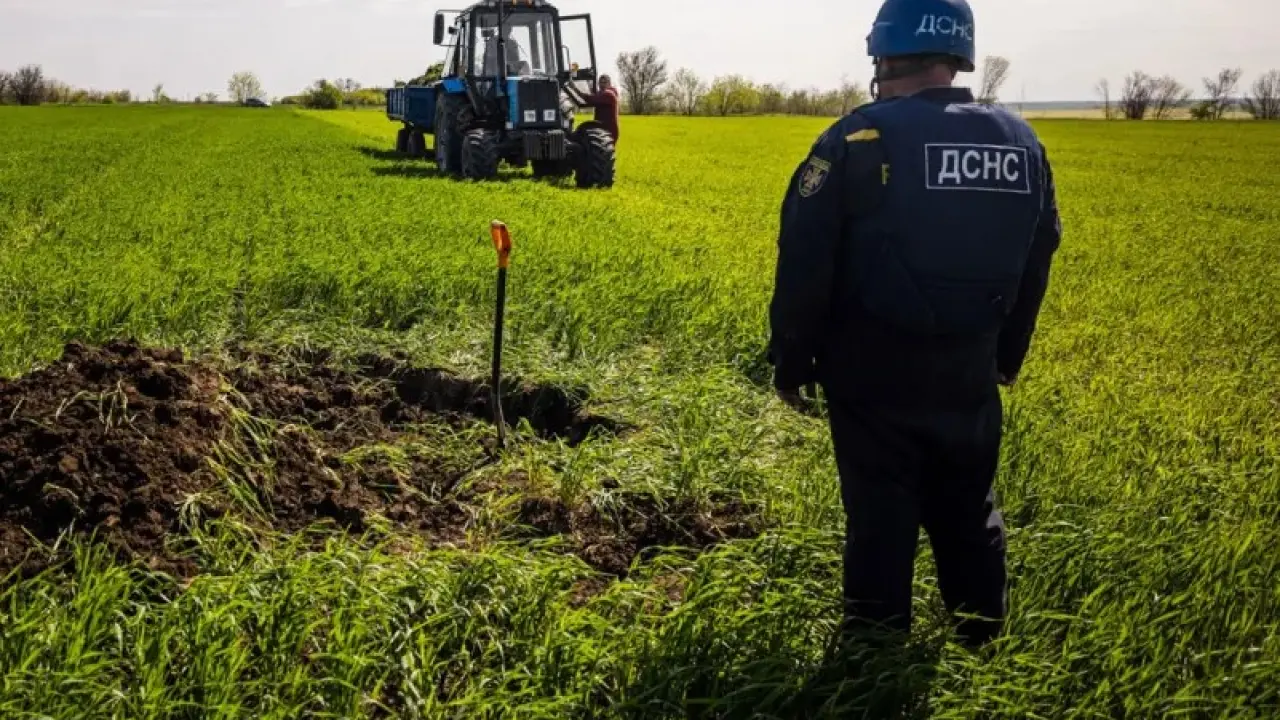
Russia’s war in Ukraine has turned agricultural land into part of the battlefield.
Since Russia launched its full-scale invasion in February 2022, fighting has damaged farmland, destroyed agricultural machinery, and forced rural families from their homes. In frontline areas, the danger continues long after battles move elsewhere, with mines, unexploded ammunition, damaged infrastructure, and disrupted electricity supplies make returning to normal farming difficult.
The scale of the damage is substantial. Ukraine’s agricultural sector has suffered an estimated $83.9 billion in damage and losses since the war began, according to a 2025 assessment cited by the United Nations. Irrigation, meanwhile, has sustained an additional $1.6 billion in damage.
Ukrainian Farmers Risk Their Lives to Save Their Land
In the southern Kherson region, farmer Roman Zavhorodnii and his workers use drone detectors, electronic warfare equipment, radios, and shotguns to protect themselves while harvesting.
Work that once took two or three weeks can now stretch beyond two months as crews repeatedly flee approaching drones and return when it is safe.
For Viktor Hordiienko, the danger is personal. His father, Oleksandr, became known for clearing mines from farmland and trying to shoot down Russian drones. He was killed in a drone strike in September 2025. Viktor continued farming, but mounting debt, destroyed machinery, and attacks on workers have pushed him toward suspending operations.
In 2026, his farm’s last remaining combine harvester was destroyed by a Russian drone while harvesting wheat. His experience reflects the impossible choices facing farmers, whether to risk lives and valuable equipment to save a harvest, or abandon the work that sustains their families.
On another field, brothers Valerii and Yurii returned to Dovhenke after the Russian occupation destroyed their home and equipment. They rebuilt a tractor from parts of two wrecked machines and began farming again, while demining teams worked to clear their land. Their determination shows why farmland is more than an economic asset, it represents home, identity, and the possibility of rebuilding a community.
Ukraine’s Food Security and Global Stakes
The consequences extend beyond individual farms. When farmers cannot plant or harvest on time, rural families lose income and Ukraine loses productive capacity. Falling local grain prices, rising costs, and damaged export routes further weaken farms already struggling to recover.
The effects on soil and ecosystems may last long after fighting ends. Farmers have reported poor crop growth around shell craters, suspected soil contamination, and disappearing wildlife. Clearing mines is therefore only the first step toward restoring productive farmland.
International assistance has helped families access seeds, equipment, and demining support, but the United Nations has warned that funding gaps threaten recovery efforts.
Ukraine’s ability to restore agriculture will depend on sustained support, safe access to land, and financial conditions that allow small farms to survive.
Ukraine’s fields are part of a wider geopolitical struggle. Protecting agricultural production means protecting livelihoods, supporting national resilience, and helping maintain food supplies beyond the country’s borders. If farmers cannot safely return to their land, the costs of war will continue to grow long after the guns fall silent.

Loading comments...