




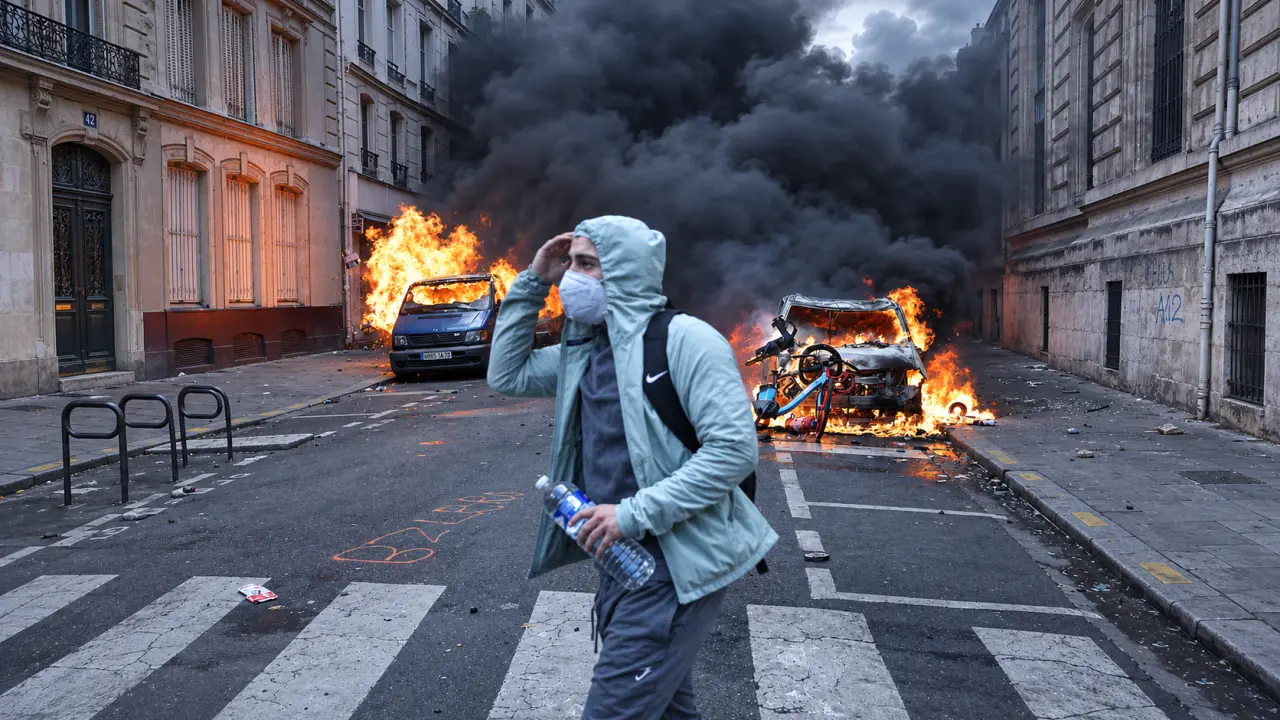
For decades, Western Europe grew accustomed to watching wars unfold from afar, first on television and later on smartphone screens. Now, as European governments back Ukraine against Russia, Europeans are discovering that war can reach their own doorsteps. Sowing chaos no longer requires tanks crossing borders or warplanes bombing cities. All it takes is a remote attack on the systems that keep everyday life running.
France, one of the main pillars of the European Union, is facing a growing political crisis at home and mounting pressure from abroad. President Emmanuel Macron is struggling with soaring debt, spending cuts, and public anger. Russian disinformation networks and accounts linked to Israeli figures are exploiting the unrest, while Iran is adding to the chaos through cyber sabotage.
With the presidential election approaching in April 2027, France's internal turmoil has very quickly become a geopolitical battleground.
From Burning Freezers to Blood Banks
On November 9, France accused Iran of orchestrating a wave of cyberattacks that sabotaged refrigeration systems at around 700 supermarkets and other businesses throughout the month of October. The attackers remotely manipulated temperatures, destroying millions of dollars in fresh and frozen food and causing some refrigeration units to catch fire.
French Foreign Minister Jean-Noël Barrot described the sabotage as an attack of unprecedented scale and aggressiveness, calling it the first major cyberattack intended to cause physical damage on French soil. The offensive did not stop in France. In November, fresh cyberattacks targeted supermarkets in Sweden, Belgium, and Ireland.
An even more alarming incident struck three French facilities storing blood plasma, where attackers manipulated refrigeration systems and put lifesaving supplies at risk. Alarms prevented any plasma losses, but the incidents exposed the vulnerability of critical medical supplies.
It appears that Tehran's cyber sabotage was intended to punish Paris and demonstrate that Iran could strike France on its own soil. France played a decisive role after Iran attacked the United Arab Emirates, Qatar, Kuwait, and Bahrain. Paris openly sided with those countries, reinforced its military deployment in the Gulf, and directly participated in defensive operations, intercepting Iranian drones and missiles.
The cyberattacks come as the European Union and the United Kingdom promote civil emergency preparedness campaigns urging citizens to stockpile food, water, and other essential supplies to survive at least 72 hours without government assistance.
Regime Change in France at Any Cost
On November 9, Reuters revealed that separate internal assessments by the European Union and France's foreign ministry had identified a covert Russian network and accounts linked to Israeli officials and the US MAGA movement exploiting October's unrest to inflame social tensions, fuel fears of chaos, and portray France as a country on the brink of collapse.
In recent months, Moscow has flooded French social media with fabricated videos mimicking Western news broadcasts. The clips falsely blamed undocumented immigrants for violent sexual assaults and circulated bogus reports of terrorist attacks.
Russia is targeting France because it supplies weapons to Ukraine and, alongside the United Kingdom, leads an international coalition supporting Kyiv. In response, Russian propaganda has sought to turn France's economic troubles against that commitment, portraying Macron as a president who spends billions helping Ukraine while French citizens face spending cuts and mounting hardship.
The timing could hardly be more consequential. France will elect its next president in five months, with far-right leader Marine Le Pen leading in the polls. A longtime critic of European integration who has cultivated close ties with Vladimir Putin, Le Pen is campaigning on a promise to restore order.
Why Israel Has Stakes in France
In addition to Russia's disinformation, the French government also documented hundreds of posts by Israeli officials, media outlets, and public figures blaming unrest in Paris and other French cities on radical Islamism and immigration. Their reach was massive: between October 16-18, the ten most widely viewed posts generated more than 35 million views, helping portray France as a country overwhelmed by violence and insecurity.
Following France's recognition of Palestinian statehood on September 22, 2025, far-right Israeli factions are seeking Macron's downfall and an end to his Middle East policies, portraying the unrest as proof that his government has lost control of immigration and domestic security.
A similar controversy erupted in Spain, where Israeli and Moroccan intelligence services were accused of orchestrating Ceuta's massive migrant crisis to destabilize Pedro Sánchez's government in retaliation for Madrid's support for Palestinian statehood.
Taken all together, France is facing an unprecedented situation. The European Union project ended centuries of bitter rivalry and war between nations. Brexit shook its foundations. If France, one of its main pillars, falls next, the entire European structure could come crashing down.

Loading comments...