




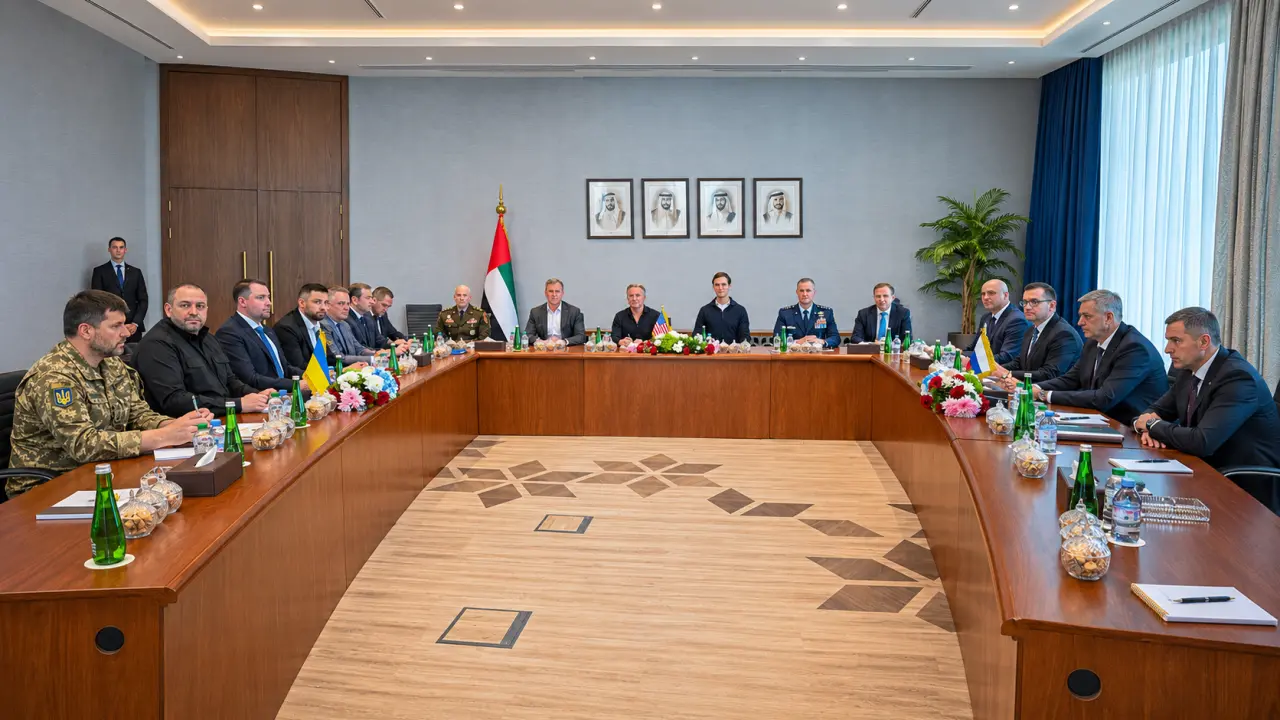
On November 10-11, 2026, Russia, Ukraine and the United States resumed trilateral peace talks in Abu Dhabi. The meeting was the first in this format since February and formed part of President Donald Trump’s renewed effort to end a war lasting more than four and a half years.
The first session lasted nearly four hours and focused on humanitarian measures, de-escalation and Ukraine’s long-term security. Ukrainian President Volodymyr Zelenskyy called it constructive, but no ceasefire or comprehensive agreement was announced.
The question remains, can Washington turn renewed contact into a path to peace while Moscow and Kyiv remain divided over territory and security?
Abu Dhabi Reopens the Diplomatic Channel Between Russia and Ukraine
The United Arab Emirates hosted the talks. The US delegation was led by special envoy Steve Witkoff and Jared Kushner, Trump’s son-in-law. Ukraine’s team was headed by Rustem Umerov, alongside senior officials including presidential chief of staff Kyrylo Budanov. Russia sent a delegation led by presidential aide Vladimir Medinsky, with senior diplomatic, intelligence and military officials.
The first day included discussions on prisoner exchanges, the return of detained Ukrainian civilians and children, and de-escalation. Zelenskyy said negotiators also examined long-term security guarantees. A large prisoner exchange was discussed, but no final number, date or signed agreement had been announced as talks entered their second day on November 11.
Diplomacy continued even as fighting intensified. On November 10, Russian strikes hit energy infrastructure in several Ukrainian regions, causing power outages as winter approached. The attacks highlighted the gap between negotiations and battlefield conditions.
Territory, NATO, and Security Guarantees Remain Major Obstacles
The main political differences remain unresolved. Moscow wants Ukraine to withdraw from parts of four regions Russia claims to have annexed: Donetsk, Luhansk, Zaporizhzhia and Kherson. It also demands that Kyiv abandon its ambition to join NATO and accept limits on its military. Ukraine rejects territorial concessions and restrictions on its defense forces, saying they could leave the country exposed to another invasion.
Kyiv has called for a ceasefire as the first step toward a wider settlement and wants credible, long-term security guarantees. Moscow rejects an unconditional halt to the fighting, arguing that a pause would allow Ukrainian forces to regroup. The sides disagree on both the terms of peace and the order of negotiations.
Europe's Role and the Future of Trump's Peace Initiative
The expanded talks have unsettled European governments, many of which are already seeking greater defense autonomy from Washington, amid fears that a Trump-Putin deal could constrain NATO's military presence in Eastern Europe, where Poland has warned of Russian attacks disguised as accidents.
Kushner highlighted another obstacle: Europe's struggle to speak with one voice. "If Europe could identify one person who speaks on its behalf, that would be a greater achievement than getting the Russians to include that person in the negotiations," he said.
European leaders have debated opening a direct channel to Putin, but have yet to agree on who should represent them. The leaders of Norway and Finland have recently spoken with the Russian president, while German Chancellor Friedrich Merz said he was willing to do so. No common representative has emerged.
Ultimately, the Abu Dhabi talks are a diplomatic opening, not proof that peace is near. The prisoner exchange may build confidence but territorial claims and security guarantees will continue to be hard to resolve.
Trump’s ability to maintain pressure on Moscow while reassuring Kyiv and its European partners will shape the next stage. Key signs to watch include concrete de-escalation, an agreed prisoner exchange, credible security commitments and progress toward a leaders’ meeting involving Putin and Zelenskyy. Without movement on these issues, talks may keep diplomacy alive but will not end the war.
Loading comments...