




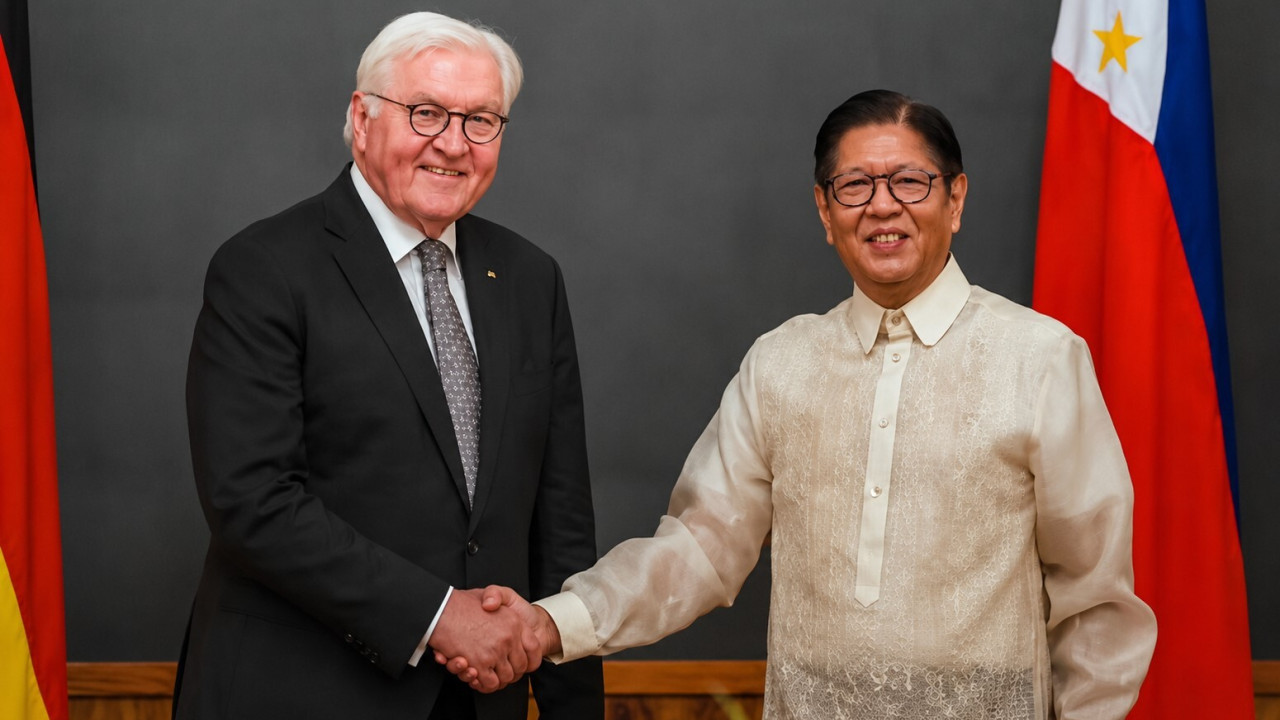
Germany has now said aloud what many governments won't: any major crisis in the South China Sea would quickly spill across the global economy.
Speaking in Manila beside Philippine President Ferdinand Marcos Jr., German President Frank-Walter Steinmeier warned that Europe is closely watching the rising tensions in the disputed waters. His message was not only about expressing support for the Philippines in light of Chinese aggression, but also a warning about the fragility of the sea routes that keep the global economy alive.
Why Germany’s Concern Is Growing
Steinmeier linked the South China Sea, and specifically the West Philippine Sea, directly to the recent blockade of the Strait of Hormuz, where the US-Israeli war on Iran has shaken global confidence and driven up fuel and fertilizer prices. The crisis has shown how fast a maritime blockade can move from a seemingly small security problem to a global economic shock.
Because of this, Europe is increasingly viewing the West Philippine Sea and the broader South China Sea as a strategic trade corridor rather than a distant regional dispute. That shift gives the Philippines greater diplomatic support because the dispute is no longer being seen only as a regional sovereignty issue, but also a global trade and security concern. This makes it harder for Beijing to portray tensions as a purely bilateral issue.
Steinmeier did not directly name China during his remarks, but the target of the concern was clear. “The situation in the West Philippine Sea continues to be tense,” Steinmeier said through an interpreter, adding that Southeast Asia is one of the world’s most dynamic economic regions. When incidents happen there, he said, they become a serious concern for Europe as well.
PH Coast Guard Is on the Frontline
During his remarks, Steinmeier pledged to continue Germany's support for the Philippine Coast Guard (PCG), which has become Manila’s most visible defender in the WPS.
The PCG has been at the center of repeated altercations with Chinese forces, including dangerous maneuvers and collisions involving Philippine vessels. It has also played a crucial role in exposing incidents that Beijing might prefer to keep hidden at sea.
Even before Steinmeier, Germany had signaled where it stood. In 2024, Germany's then-Foreign Minister Annalena Baerbock visited the PCG headquarters in Manila and even boarded a patrol ship for a tour. During her visit, she said China’s actions in the disputed waters were not allowed under international law and raised concern in Europe because they violated the rights and economic opportunities of coastal states.
For his part, President Marcos thanked Germany for publicly backing Philippine efforts to uphold the rule of law in the WPS. He also pointed to Berlin’s support for the 2016 Arbitral Award, the landmark ruling that invalidated China’s expansive claims under the UN Convention on the Law of the Sea.
China’s Aggression Is Increasingly Costly
The real significance of Steinmeier’s warning is that it moves the West Philippine Sea dispute beyond the frame Beijing prefers. For years, Beijing has tried to present the issue as a matter between itself and its neighbors, warning outside powers not to interfere.
Germany’s message challenges that framing by treating the waters near the Philippines as part of a global trade and security system that matters to the international community. If freedom of navigation is threatened in the region, Europe can still be affected.
This matters because the Philippines is no longer facing Beijing alone. Every government that recognizes the arbitral ruling and supports the Philippines’ maritime rights weakens China’s effort to present its claims as internationally accepted. The more countries that challenge Beijing’s narrative, the higher the political cost of its illegal actions sea.
Loading comments...