




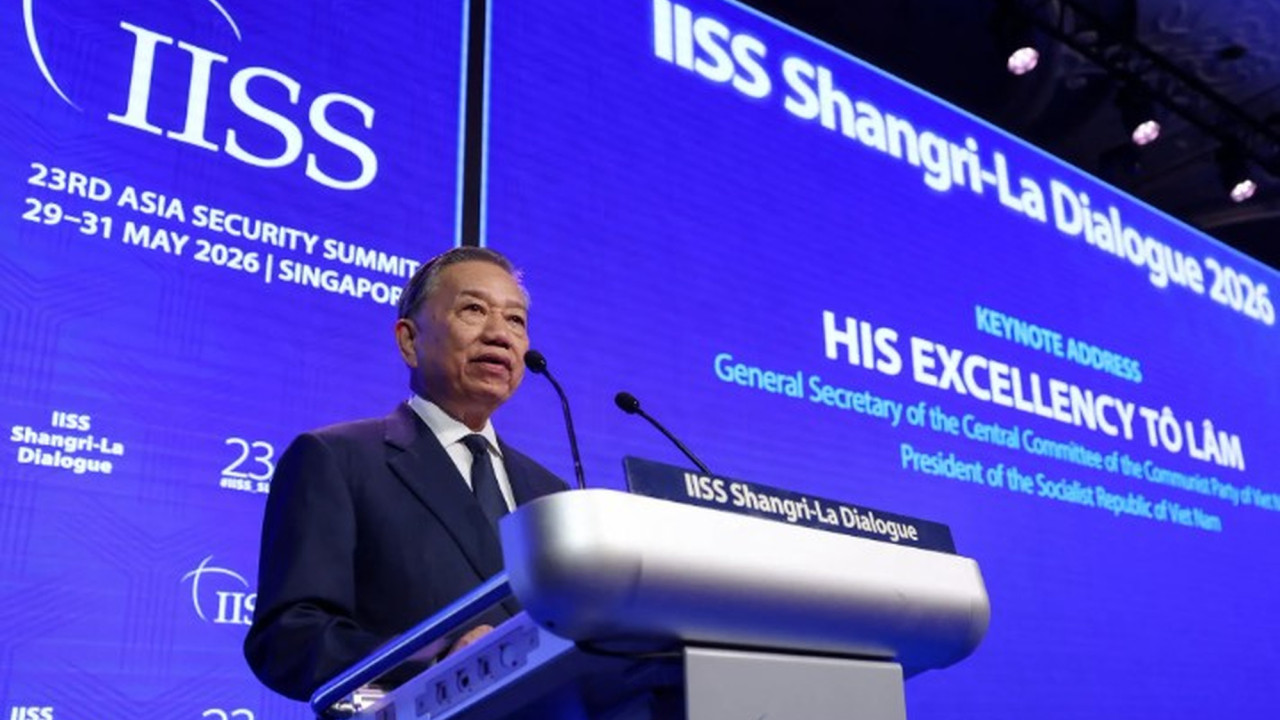
The Shangri-La Dialogue in Singapore is Asia’s leading security forum, but this year it revealed more divergence than consensus. The main divide was not between the United States and China, but between Washington and several Southeast Asian governments over how regional security should be understood.
Chinese Defense Minister Dong Jun was absent for a second consecutive year. That created more space for US messaging, but it did not translate into closer alignment with regional partners. Instead, speeches highlighted different strategic priorities.
The United States focused on deterrence, military strength, and increased defense spending to counter China’s growing influence. Many Southeast Asian governments emphasized a different set of priorities, including sovereignty, international law, dialogue, and strategic autonomy.
Vietnam Warns Against Great Power Pressure
Vietnam’s opening address, delivered by General Secretary To Lam, captured this alternative framing. He stressed peace, development, and a rules-based international order, warning against unchecked competition and selective enforcement of international law. His message reflected a core regional concern that rules lose legitimacy when they are applied unevenly by major powers. When rules become flexible for the powerful, small and medium-sized states are left in a world where “the big eat the small.”
Vietnam’s approach, often described as bamboo diplomacy, is designed to preserve autonomy while maintaining relations with both the United States and China. It avoids formal alignment while maximizing room for maneuver.
At the same time, Hanoi is expanding cooperation in areas such as cybersecurity, artificial intelligence, undersea cable protection, and maritime security. These forms of non-traditional security cooperation allow Vietnam to deepen external partnerships without triggering direct geopolitical confrontation.
US Messaging Highlights an Ongoing Tension
US Defense Secretary Pete Hegseth emphasized deterrence, alliance coordination, and the need to resist Chinese hegemony in the Indo-Pacific. He also called on regional partners to increase defense spending and strengthen burden sharing.
While many Southeast Asian states support a continued US presence, they remain cautious about the political and economic implications of deeper alignment. For them, security cooperation cannot come at the cost of strategic flexibility.
Uncertainty about US commitments and escalation thresholds continues to shape regional calculations. This was reinforced by the limited reference to Taiwan in this year’s speech, which stood in contrast to previous forums where the issue was more prominent.
Malaysia Signals Concerns Over Consistency in Global Rules
Malaysia added another layer to the discussion. Its defense minister, Mohamed Khaled Nordin, criticized what he described as double standards in the application of international law.
He argued that smaller states often face pressure for violations that are treated differently when committed by major powers. His remarks reflected a broader concern in Southeast Asia about the credibility and consistency of global rules.
Together with Vietnam’s position, this underscores a regional preference for a rules-based order that is seen as even-handed rather than hierarchical.
Southeast Asia Is Not Aligning, It Is Positioning
The Shangri-La Dialogue did not produce a clear strategic shift, but it clarified an existing divide. The United States continues to frame Indo-Pacific security in terms of deterrence and alignment. Much of Southeast Asia frames it in terms of balance, autonomy, and risk management.
The result is not a contest over choosing sides. It is a mismatch in strategic language. Washington is speaking in the vocabulary of power projection. Southeast Asia is speaking in the vocabulary of flexibility and constraint.
That gap now defines the region’s security politics as much as any military balance.
Loading comments...