




Editor's Note: This article is Part 1 of a three-part investigative series examining how climate change is reshaping health across Southeast Asia. Part 1 explores the spread of climate-sensitive diseases in the Philippines, Part 2 investigates the hidden health consequences of disasters in Vietnam, and Part 3 examines the growing mental health burden of environmental change.
Climate change is increasingly being measured not only in stronger storms and rising seas, but also in disease. Across Southeast Asia, warming temperatures, shifting rainfall patterns, and more frequent floods are changing the conditions in which pathogens spread and communities recover. These changes are contributing to rising concerns over dengue, leptospirosis, and other climate-sensitive illnesses.
As climate hazards intensify, health experts warn that outbreaks are becoming harder to predict and control, exposing the growing links between environmental change and public health.
Rising Temperatures Are Changing the Geography of Disease
Climate change is not only transforming ecosystems, but also reshaping how diseases spread. According to the United Nations Framework Convention on Climate Change (UNFCCC), warmer temperatures and changing rainfall patterns can lengthen the transmission season of diseases such as dengue and expand the areas where they thrive. Water-borne diseases are also highly sensitive to changing climatic conditions.
Few countries illustrate these risks more clearly than the Philippines. The country experiences an average of nineteen to twenty tropical cyclones each year, with seven to nine making landfall. As one of the world's most disaster-prone nations, it is confronting rising temperatures, heavier rainfall, and increasingly extreme weather events.
The health consequences are already visible. By June 29, 2024, the Department of Health (DOH) had recorded more than 90,000 dengue cases and 233 deaths nationwide. Cases were 19 percent higher than during the same period in 2023. Health officials partly attributed the increase to rainfall creating stagnant pools of water where Aedes aegypti mosquitoes breed.
Unlike many mosquito species, Aedes aegypti is highly adapted to urban environments. It frequently breeds in water containers, drains, and other man-made environments, making densely populated cities especially vulnerable to outbreaks.
Dengue itself is not new to the Philippines. What is changing is the environment in which it spreads. Climate change may not create new pathogens, but it can create conditions that allow existing diseases to persist for longer periods and expand into new locations.
The trend is increasingly evident in urban areas. In Quezon City alone, dengue cases reached 6,981 between January and August 2025, representing a 155 percent increase compared with the previous year. Children aged ten and below were among the most affected.
Floods Are Turning Cities Into Public Health Hotspots
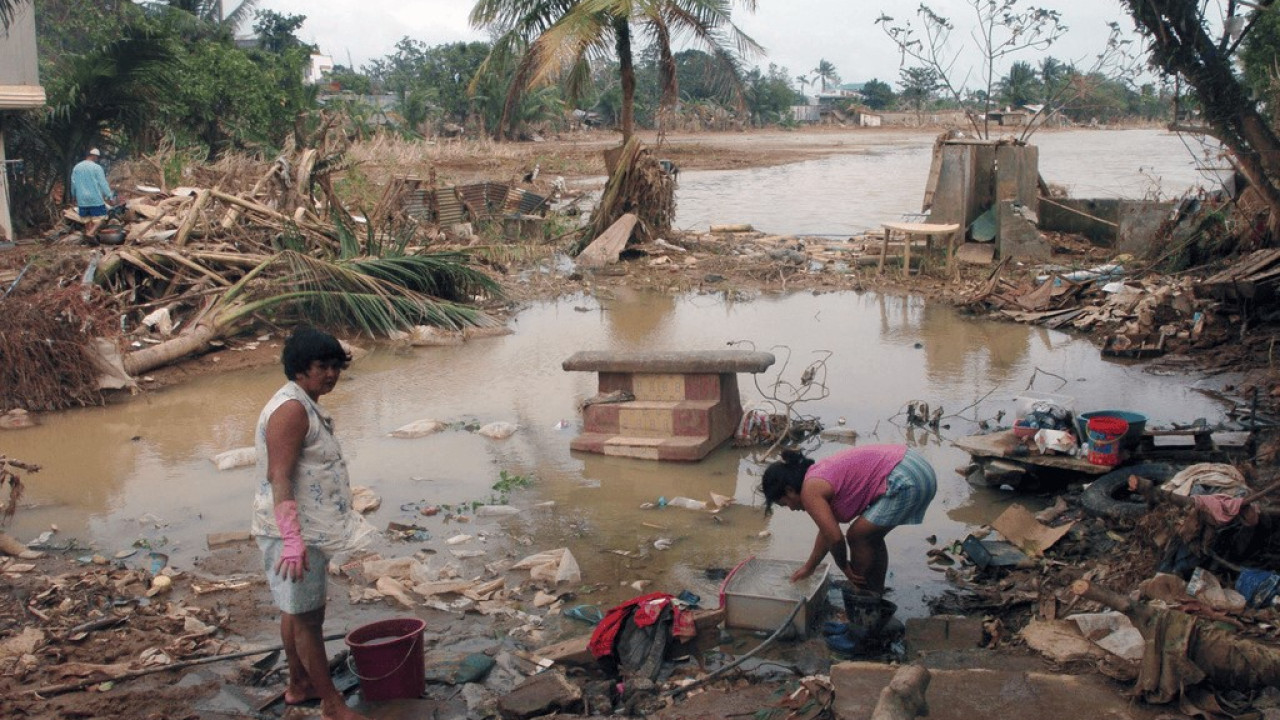
In many Philippine cities, climate risks are colliding with rapid urbanization. Health experts warn that floods triggered by typhoons and heavy monsoon rains are increasingly driving outbreaks of both dengue and leptospirosis.
Leptospirosis has emerged as a growing concern. The bacterial disease spreads through floodwaters contaminated by animal waste, particularly from rats. By late August 2025, Quezon City had recorded 521 cases and 74 deaths, with nearly 79% of infections linked to exposure to contaminated floodwaters.
These outbreaks demonstrate how climate hazards interact with long-standing weaknesses in infrastructure and urban planning. Researchers and public health officials have argued that inadequate flood-control systems and unregulated development leave many communities vulnerable when heavy rains arrive.
The risks are not shared equally. Nearly 45% of the urban population lives in informal settlements, many located in flood-prone areas. Rapid migration toward Metro Manila has increased exposure to environmental hazards, while poorer communities often have fewer resources to prepare for or recover from disasters.
Climate change is therefore becoming not only a public health challenge, but also a question of social equity. Children, low-income households, and marginalized communities are often the most exposed and the least equipped to cope.
Preparing for a Climate-Health Future
The growing health burden has forced policymakers to rethink how the country responds to climate risks.
In 2025, the Philippine Department of Health, with support from the World Health Organization and academic institutions, launched the Philippine Health and Climate Change Roadmap 2025–2050. The strategy recognizes that climate change affects not only disease patterns, but also healthcare access, nutrition, mental health, and community resilience.
The roadmap seeks to build a more climate-resilient health system through stronger disease surveillance, improved early warning systems, resilient healthcare infrastructure, and closer coordination across government agencies. A dedicated Health and Climate Change Office has also been established within the Department of Health.
These efforts reflect a broader shift in thinking. Climate adaptation can no longer focus solely on seawalls and flood barriers. Hospitals, public health systems, and local communities must also prepare for a future in which outbreaks become more frequent and less predictable.
The Philippines offers an important lesson for Southeast Asia. As temperatures rise across the region, climate change is increasingly shaping who gets sick, where diseases spread, and how governments respond.
The health impacts of a warming world are no longer distant threats measured only in degrees Celsius or sea-level rise. They are already unfolding in clinics, homes, and communities across Southeast Asia.
Loading comments...