




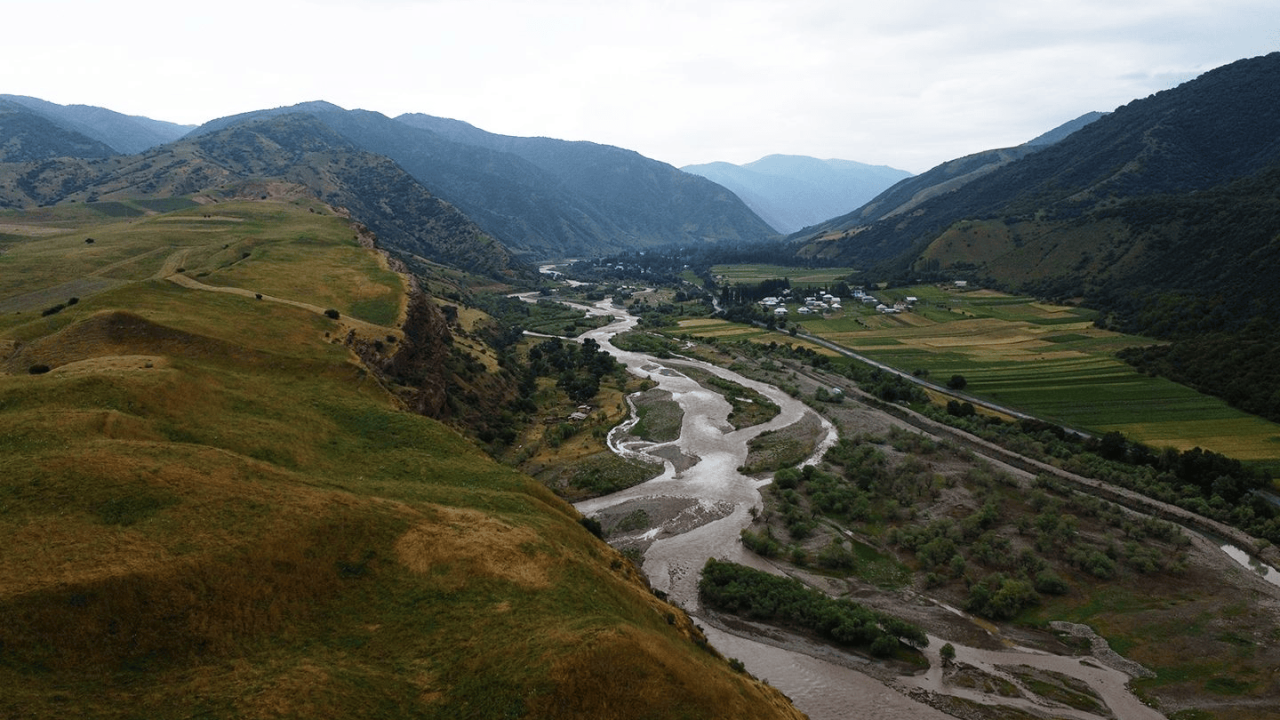
Central Asia has long depended on rivers fed by mountain glaciers to support its cities, farms, and industries. Today, that system is under pressure.
Rising temperatures, shrinking glaciers, and growing demand for water are creating new challenges across the region. While Central Asia is often described as water-rich, experts increasingly warn that the real problem is not only how much water exists, but whether enough will be available where and when it is needed.
Countries such as Turkmenistan and Uzbekistan face particular risks because their economies depend heavily on irrigation and water flowing from rivers that begin beyond their borders.
Melting Glaciers Are Changing the Region's Water Supply
The glaciers of the Tian Shan and Pamir mountain ranges feed Central Asia's most important rivers, including the Amu Darya and Syr Darya. These waterways support agriculture, drinking water supply, and ecosystems across Kazakhstan, Kyrgyzstan, Tajikistan, Turkmenistan, and Uzbekistan.
Data shows glacier loss has accelerated in recent years. Researchers estimate that the Tien Shan mountains have lost around 27% of their ice mass since the 1960s, while Kyrgyzstan's glacier area has shrunk by 16% over the past 70 years and more than 1,000 glaciers have vanished in Tajikistan. While faster melting can temporarily increase river flows, experts warn this is only a short-term effect. As glaciers continue to shrink, river levels will eventually decline.
For Turkmenistan, the threat is especially serious. The country receives very little rainfall and relies on the Amu Darya River for about 90% of its water supply. Any long-term reduction in river flow would place enormous pressure on farms, communities, and the environment.
Beyond glacier melt, other climate problems are also impacting the region. Droughts are becoming more frequent, rainfall patterns are shifting, and evaporation rates are increasing as temperatures rise.
How the Soviet Water System Kept the Region Connected
Many of today's water challenges can be traced back to the Soviet Union, the former state that governed Central Asia from 1922 to 1991 through a centrally planned system that controlled all water, energy, and agricultural production across the region.
During the Soviet era, Central Asia had a shared water and energy system. Water-rich upstream republics such as Kyrgyzstan and Tajikistan released water from reservoirs to support cotton farming in downstream areas of Kazakhstan, Uzbekistan, and Turkmenistan. In return, the downstream republics supplied coal, gas, and electricity.
The Soviet Union built an extensive network of canals, reservoirs, and dams that transformed large areas of arid land into major agricultural zones. The system treated water and energy as regional resources rather than national assets.
After the Soviet Union collapsed in 1991, that arrangement broke apart. Independent governments began pursuing their own priorities, turning water from a shared economic resource into a strategic national issue that continues to shape regional politics today.
The Soviet legacy also left behind an aging infrastructure network that is struggling to meet today's needs. Many of the canals, reservoirs, and irrigation systems built decades ago remain in use across Central Asia, yet they are falling apart.
This means the region is facing a double challenge. Climate change is putting pressure on water supplies, while inefficient infrastructure continues to waste large amounts of the water that remains available.
Water Security at a Turning Point
Central Asia is not running out of water overnight. But the combination of melting glaciers, inefficient water use, and growing competition suggests the region is entering a new era. Historical water-sharing arrangements were designed for a different climate and a different political landscape.
The region's challenge is no longer simply managing water. It is adapting an entire system built for the twentieth century to the realities of the twenty-first. Whether governments can modernize infrastructure, improve cooperation, and manage shrinking resources may determine the region's long-term water, food, and energy security.


Loading comments...