




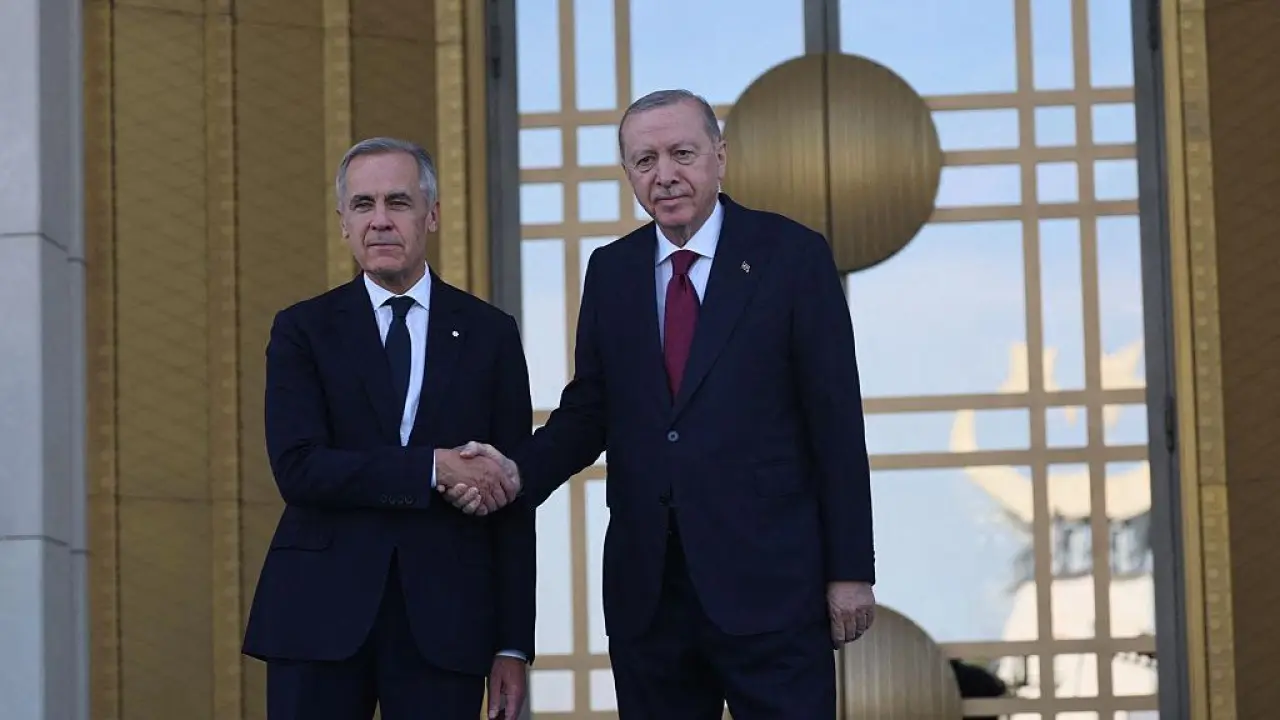
On October 22, Canadian Prime Minister Mark Carney and Turkish President Recep Tayyip Erdoğan announced a strategic partnership in Ankara, marking a major shift in relations between two NATO allies whose ties had been strained by Canadian arms export restrictions.
During the first bilateral visit by a Canadian prime minister to Turkey, the two governments agreed on a three-year cooperation plan covering trade, liquefied natural gas (LNG), nuclear energy, critical minerals, defense, and diplomatic coordination. They also announced plans for free trade negotiations, new defense industry cooperation, and an annual strategic dialogue.
The first round of trade negotiations is scheduled for November 30 to December 4, with both governments seeking to reduce tariffs and regulatory barriers.
The partnership serves different strategic goals for Ottawa and Ankara. Canada wants to reduce its economic dependence on the United States, while Turkey seeks to expand its commercial and military partnerships without sacrificing its foreign policy autonomy.
Canada Seeks New Markets and Energy Opportunities
Ottawa aims to double Canadian exports to non-US markets over the next decade. In this regard, Turkey offers a potential gateway to Europe, the Middle East, and Asia through its extensive commercial and industrial networks. Although Turkey is not an EU member, it maintains a customs union with the bloc that gives it preference in certain industries.
The agreement could also help Canada address its trade imbalance with Turkey. Two-way merchandise trade reached approximately $4.3 billion in 2025, including $1.1 billion in Canadian exports and $3.2 billion in imports from Turkey.
Energy is another central pillar of the partnership. Both governments have identified LNG, critical minerals, and renewable technologies as priorities, but nuclear power offers the most concrete opportunity.
Canadian engineering company AtkinsRéalis is exploring the potential use of CANDU reactors at Turkey's planned Sinop nuclear power plant on the Black Sea coast. The contract has yet to be awarded, but a successful Canadian bid could establish decades of technological and industrial cooperation.
From Arms Restrictions to Defense Cooperation
In 2019, Canada restricted military exports to Turkey following Ankara's military intervention in northeastern Syria. Ottawa imposed further restrictions in 2020 after Canadian technology was found in Turkish-made drones used during the Nagorno-Karabakh conflict.
The measures strained relations between the two NATO allies and disrupted cooperation between their defense industries. Although Canada eased its export licensing policy in January 2024, military sales remain subject to individual assessments and end-use guarantees.
Both governments have now signed a memorandum of understanding aimed at expanding defense industry cooperation, particularly in unmanned systems, aerospace technology, and military manufacturing. The shift opens new commercial opportunities, although questions remain over technology transfers and the final destination of military equipment.
Why the Partnership Matters for European Security
The rapprochement also carries implications for European security. Canada leads a multinational NATO brigade in Latvia and remains an active supporter of Ukraine.
Turkey, meanwhile, controls the strategic waterways connecting the Black Sea to the Mediterranean and maintains relations with both Moscow and Kyiv.
Following Russia's invasion of Ukraine, Ankara restricted the passage of belligerent warships through the Turkish Straits and continued providing military support to Kyiv. However, Turkey did not join Western sanctions against Moscow, preserving significant economic and energy ties with Russia.
This balancing strategy reflects Erdoğan's determination to maintain strategic autonomy, even when Turkish policies create friction within NATO.
For Canada, Turkey's ability to maintain ties with both Russia and Ukraine makes Ankara a potentially valuable diplomatic partner, even when the two NATO allies disagree on how to confront Moscow.
Closer ties could also strengthen coordination on maritime security and other regional challenges, including the Middle East, where Turkey remains an influential diplomatic actor.
The partnership will soon face its first practical tests. Trade negotiations beginning in late November, the selection of a nuclear supplier for Sinop, and the launch of joint defense projects will show whether the two governments can turn their diplomatic breakthrough into a lasting strategic partnership.


Loading comments...