




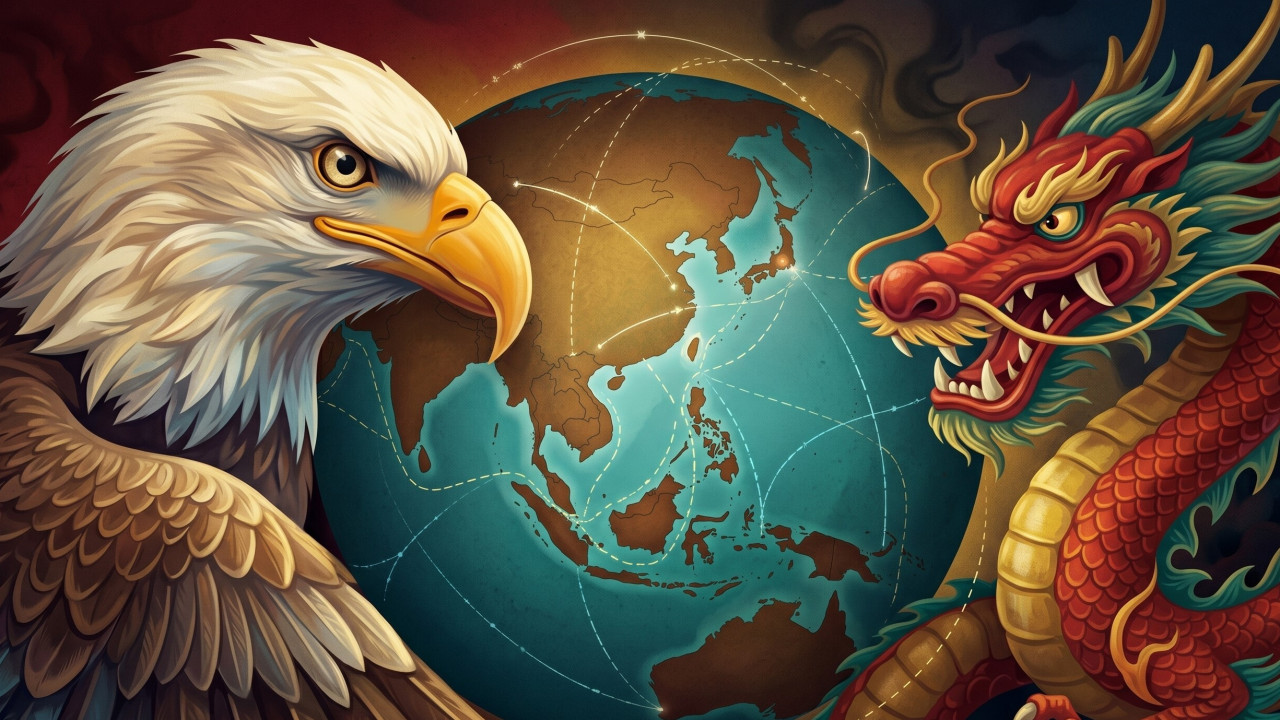
For more than three decades after the Cold War, the world lived under a system shaped by one dominant power: the United States. That era is now ending. China’s rise, Russia’s assault on the post-Cold War order, and growing strains in the West all point to a world that is becoming more contested and more dangerous.
The question is not whether the old order will survive. It will not. The real question is what replaces it. The world could break into rival regional spheres of influence, where powerful states dominate their neighborhoods and weaker countries are forced to submit. It could descend into a harsher every-country-for-itself system, where international rules matter less and conquest becomes easier to justify. Or it could settle into a new bipolar rivalry centered on Washington and Beijing.
A new Cold War between the United States and China would be grim. It would bring economic fragmentation, proxy conflicts, military tension, and a more divided world. But compared with the alternatives, it may also be the least dangerous future. A structured rivalry between two blocs would not eliminate crises, but it could contain them. It could impose limits, restore deterrence, and reduce the risk that today’s disorder ends in something far worse.
The Disappearance of the Old Order
Today, it is common to hear world leaders say that the old world order no longer exists. They are referring to the structure of rules and institutions built since the end of World War II, which the United States sought to globalize after the fall of the Berlin Wall and the disintegration of the Soviet Union.
That order was characterized by the “Long Peace,” an era defined by the absence of open conflict between the major superpowers, often attributed to the fear of mutual nuclear annihilation. Few serious observers expect this to last much longer.
Russia’s war in Ukraine has shattered the assumption that borders were settled. China’s growing military pressure around Taiwan has raised the risk of a major crisis in the Pacific. At the same time, Western alliances are under strain, defense spending is rising, and major powers are increasingly treating global rules as tools to use when convenient rather than limits to respect.
What Form Could the New World Order Take?
Looking ahead, one possible outcome is a new bipolar world, with the international system increasingly divided between blocs led by Washington and Beijing. It would not be peaceful. The original Cold War came dangerously close to catastrophe on multiple occasions. But a bipolar order may still be less risky than a fragmented world where several powers test the limits of force at the same time and no clear balance exists to contain escalation.
This would not be a return to the Cold War. China has far greater economic reach than the Soviet Union ever possessed, giving Beijing powerful tools to attract partners, shape markets, and apply pressure. As competition deepens, trade, technology, investment, and supply chains could become increasingly politicized, accelerating the fragmentation of the global economy.
Like the Cold War before it, a US-China rivalry would likely draw regional disputes into a wider strategic contest. Ukraine, Taiwan, and the South China Sea could emerge as some of the most dangerous flashpoints in the new order.
A bipolar system is not necessarily a desirable outcome. But it may prove more stable than a fragmented multipolar world because power, alliances, and deterrence are easier to understand. Competition between two dominant powers would remain dangerous, yet it could be less unpredictable than a system where multiple states simultaneously challenge the status quo without a clear balance to restrain them.
A Worse Scenario: A World of Spheres of Influence
The second possibility is not a stable multipolar balance, but a world divided into spheres of influence. Russia and China have long favored a system in which major powers dominate their regions while smaller states have less freedom to choose their own path.
Such a shift could begin if the United States retreats from global leadership. China could expand its influence across the Western Pacific, while Russia pushes deeper into Eastern Europe. Elsewhere, powers such as India, Turkey, and Saudi Arabia may seek greater control over their own neighborhoods.
In this world, international institutions would weaken as regional powers increasingly set the rules. Trade, security, and diplomacy would revolve around competing spheres rather than global norms.
At first glance, this may appear more stable because it could reduce direct clashes between major powers. But that stability would come at a cost. Smaller states would face greater pressure to align with dominant neighbors, while disputes over borders and influence could spark frequent regional conflicts.
Rather than creating a more orderly world, spheres of influence could produce a more divided one—where power matters more than rules, and sovereignty becomes increasingly unequal.
The Worst Scenario: World Order Collapses Into Anarchy
Beyond bipolarity and spheres of influence lies a third and darker possibility: a world in which no power is willing or able to uphold the basic rules of international order. This scenario could emerge if the United States abandons its traditional role as the system's chief stabilizer without any other power being willing or capable of replacing it. Instead of enforcing rules, major powers would increasingly pursue their interests through coercion, territorial pressure, and economic leverage.
In such a world, smaller states would be forced to rely primarily on their own strength. Alliances would become less reliable, international institutions would weaken, and sovereignty would become harder to protect. Territorial aggression could become more common as revisionist powers test the limits of what they can seize by force.
The consequences would extend beyond warfare. Competition for strategic waterways, resources, technology, and supply chains would intensify. From the South China Sea to the Strait of Hormuz, control of key chokepoints could become a source of constant instability.
Nuclear proliferation would be one of the greatest risks. If states conclude that international guarantees no longer matter, many may decide that their own deterrent is the only reliable insurance policy.
This would not be a new world order at all. It would be the absence of one—a system defined less by rules than by power, and less by cooperation than by survival.
What makes the current moment so consequential is that all three futures remain possible. The coming decade may determine whether the world settles into a new balance of power, fragments into competing spheres, or slides toward something far more dangerous.
Loading comments...