




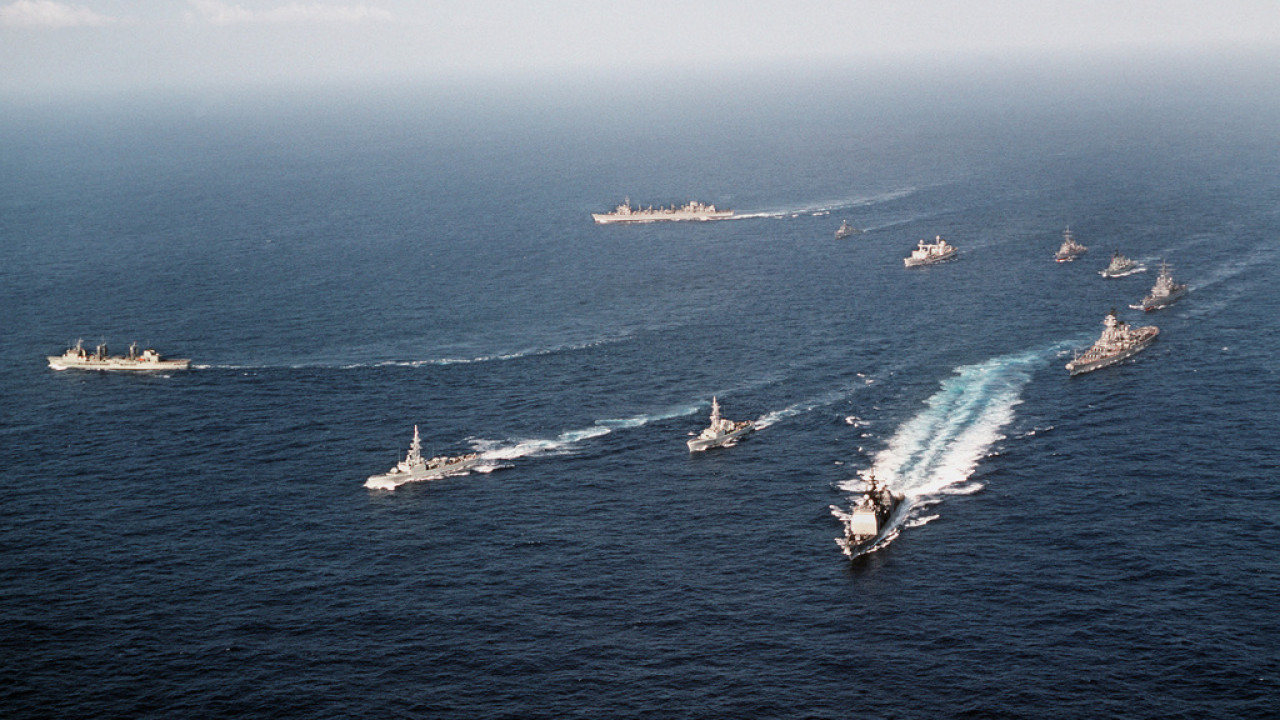
The Rim of the Pacific (RIMPAC) 2026 exercises will bring together the world’s largest coalition of maritime forces in Hawaii from June 24 to July 21. Thirty-one nations will participate, with around 25,000 personnel, 140 aircrafts, 40 surface ships, and 5 submarines expected.
Under the theme “Partners: Integrated and Prepared,” the exercise reflects a sharpening Indo-Pacific security environment where deterrence, interoperability, and interdependence increasingly overlap. For participating states, RIMPAC is about both training and strategic positioning.
Japan: From Participant to Coordinator
Japan enters RIMPAC 2026 in a visibly elevated role as Vice Commander of the exercise, a position that underscores its steady transformation into a core security coordinator in the Indo‑Pacific alongside the United States.
Within this broader command architecture, Japan’s responsibilities expand from participation to co‑leadership. The Vice Commander role places Tokyo at the center of operational planning, scenario design, and multinational command‑and‑control integration. It is a practical test of Japan’s ability to operate at scale with advanced partners while shaping the tempo and structure of coalition maritime operations.
Strategically, Japan’s expanded role aligns with its broader security trajectory. As tensions persist in the East China Sea and South China Sea, Tokyo is using RIMPAC to normalize a more active defense posture, demonstrating that its Self‑Defense Forces can coordinate, lead, and sustain complex multinational missions.
Philippines: Capacity-Building Under Pressure
The Philippines approaches RIMPAC 2026 with a narrow but urgent objective to build its maritime security capacity in light on ongoing, real-time pressure from China.
On May 4, 2026, the Philippine Coast Guard deployed BRP Gabriela Silang and BRP Miguel Malvar to the exercise. The value is experiential. Filipino crews gain exposure to advanced surveillance systems, maritime domain awareness practices, and coordinated fleet operations with some of the world’s most capable navies and coast guards. For Manila, this is direct investment in readiness amid sustained pressures in its maritime zones due to Chinese activities.
RIMPAC also reinforces a parallel acceleration in Japan-Philippines defense ties. In May, Tokyo and Manila established a Defense Equipment Working Group to coordinate potential transfers of Abukuma-class destroyers, TC-90 aircraft, surveillance platforms, and radar systems. A subsequent joint statement on May 29 reinforced plans to deepen equipment cooperation and upgrade Philippine maritime capabilities.
Indonesia: Parallel Diplomacy and Networking
Indonesia is not a central RIMPAC 2026 participant, but its trajectory mirrors the same regional logic behind the event. On May 4, 2026, Indonesia signed a Defense Cooperation Arrangement with Japan covering maritime security, joint training, humanitarian assistance, and defense equipment collaboration. This reflects Jakarta’s dual-track strategy to modernize capabilities while avoiding rigid alignment with any single country.
Indonesia is hinting towards expanding its defense network across both Asia and Europe. President Prabowo Subianto’s May 28 meeting with French President Emmanuel Macron further reinforced this approach, describing bilateral defense ties as being at their strongest level, with procurement and modernization advancing.
RIMPAC will allow Indonesia to embed itself in a widening lattice of partnerships without formal bloc commitments.
Conclusion: A Networked Maritime Order in the Making
RIMPAC 2026 is a snapshot of a shifting Indo-Pacific security architecture where interoperability, equipment sharing, and overlapping partnerships matter as much as formal alliances.
What is most likely to emerge is not a single bloc, but a layered network. Japan is moving toward operational leadership, the Philippines is turning access into capability under pressure, and Indonesia is quietly embedding itself across multiple security tracks without full alignment. Even non-participants are shaping the exercise’s strategic logic through parallel agreements and defense diplomacy.
Taken together, these developments point to a region where maritime security is becoming decentralized but more tightly connected—driven less by hierarchy and more by constant coordination among middle powers and major allies. RIMPAC 2026 reflects not just how the Indo-Pacific trains for conflict, but how it is already reorganizing itself to deter it.


Loading comments...