




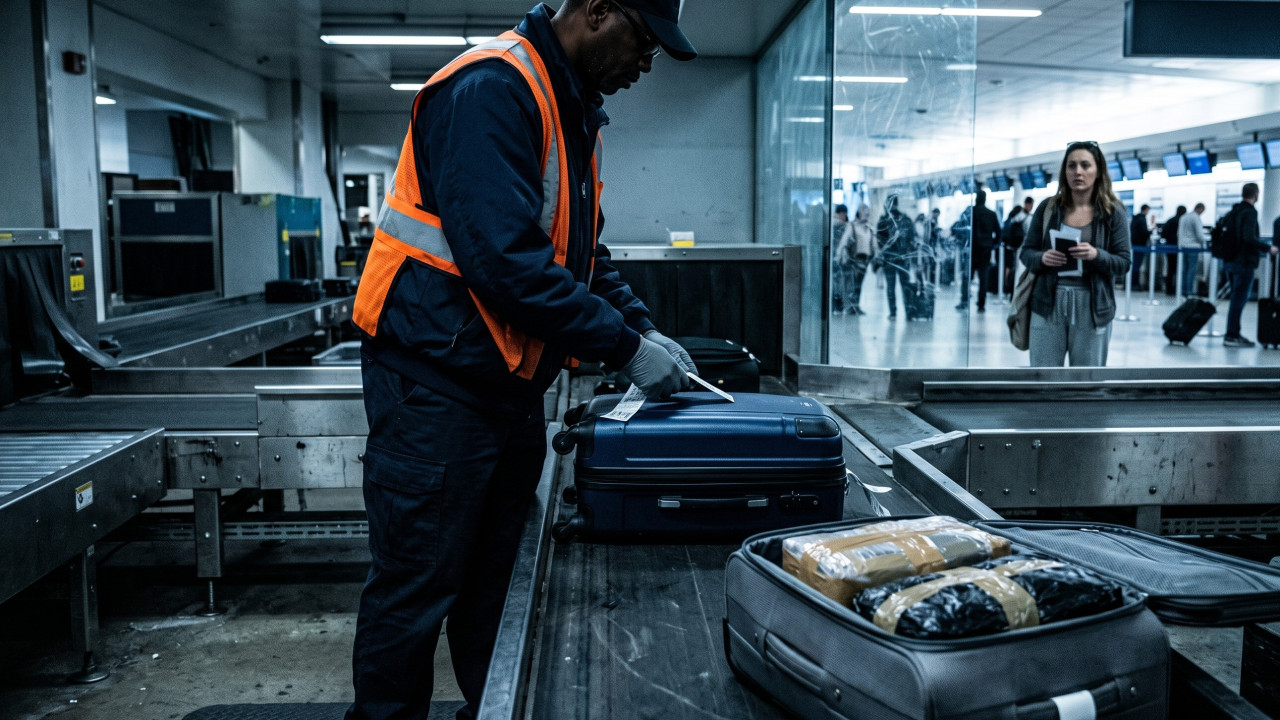
A passenger can check in a clean suitcase at Toronto Pearson, board a flight, and still land in another country with their bag packed with drugs.
That is the nightmare now facing travelers after investigators uncovered at least 17 cases in which innocent passengers were allegedly dragged into a baggage tag-switching scheme. The criminals in charge of the scheme would remove a real passenger’s luggage tag and attach it to a drug-filled bag, which meant the innocent passenger would take the fall if caught by the police.
For international travelers, the risk is not just a ruined trip. In some destinations, drug-smuggling charges can mean life in prison or even the death penalty.
Innocent Flyers Caught in a Drug Trap
The scheme came to light after baggage and ramp workers at Toronto Pearson International Airport were arrested in connection with drug trafficking operations. The cases involved routes from Canada to the Philippines, South Korea, France, Germany, Morocco, and Bermuda.
One passenger, identified only as Nicole, was preparing to fly to Auckland, New Zealand, when she was pulled off her plane and detained on suspicion of trafficking. Authorities had found a bag carrying her luggage tag. Inside were more than 45 pounds of methamphetamine.
Nicole later remembered that her bag tag had looked crumpled, a detail that suggested someone may have tampered with it. Officials eventually realized the drug-filled suitcase was not hers. Her actual luggage reached Auckland with rush tags, the labels used when bags are delayed, lost, or mishandled.
She was lucky the confusion unfolded in Canada. In another country, the same accusation could have destroyed her life before the truth was discovered.
How the Tag-Switching Scheme Works
The scheme's trick sits inside a part of air travel most passengers never see. Once a checked bag disappears behind the belt, travelers lose control over it. A corrupt airport worker with access to restricted baggage areas can remove a tag from a legitimate suitcase and place it on another bag filled with drugs.
If the drug bag reaches its destination, someone connected to the scheme can retrieve it, often using a tracking device such as an AirTag. If the bag makes it to the destination safely, a passenger may have no idea they were part of the scheme. But if police intercept the bag, the passenger whose name appears on the tag becomes the primary suspect.
Canadian police investigated a similar case involving a French national who was detained in Paris after arriving from Canada. Investigators later found that baggage tags had been manipulated without the passenger’s consent. The passenger was released and two Swissport Canada Handling employees were eventually arrested.
Another case involved two German citizens who did not know each other. They were arrested after Canadian border agents found about 145 pounds of cannabis in checked bags that were tagged in their names. Authorities later determined the bags did not belong to them, and both were released without charges.
In the Dominican Republic, the ordeal lasted much longer for a Canadian couple, Zach Crawford and Cassandra DiPietro. Their bag tag information was allegedly copied and placed on a third suitcase filled with marijuana. Crawford was eventually free to return to Canada, but DiPietro was held for court proceedings and was prevented from leaving the country. The couple spent months stuck in hotels while the case drained their money and left them traumatized.
Toronto Pearson Faces a Security Question
The arrests have exposed a brutal question for one of Canada’s busiest airports: who really controls baggage once passengers drop them off?
Toronto Pearson has thousands of cameras, but investigators reported blind spots in restricted areas. That matters because this alleged scheme depends on insider access. A passenger standing at the check-in counter cannot stop a worker from manipulating a tag once they hand them over to the airline.
The danger cuts two ways. Travelers can be tied to drugs they never touched. Airport security can also be breached by workers who know where cameras are, where bags move, and how to exploit gaps in the system.
The known cases may only show the failures that were caught. If drug bags were successfully moved under innocent passengers’ names, many travelers may have landed, collected their real luggage, and never known they had been used as cover for a smuggling operation.
That possibility makes the case more than a travel warning. It is an airport security scandal with international consequences.
What Travelers Can Do Now
Passengers cannot fully control what happens behind the belt, but they can build evidence before their bags disappear.
Travelers should take clear photos or videos of their luggage at check-in, including the attached tag, the bag’s identifying marks, and the moment it is handed over. A photo of the bag on the scale can also help show its weight before airport staff take custody of it.
Keeping the baggage receipt matters. So does using a tracker inside the suitcase, although a tracker alone may not prove a drug-filled bag is not yours. It can, however, help show where your real luggage traveled.
Some travelers now use bags with visible, hard-to-copy features and save photos alongside boarding passes and ID documents in the cloud. Others avoid checked luggage entirely when possible.
None of these steps solves the deeper problem. This is not mainly a passenger behavior story. It is a warning about how easily an airport system can turn an ordinary traveler into the victim of someone else’s crime.



Loading comments...