




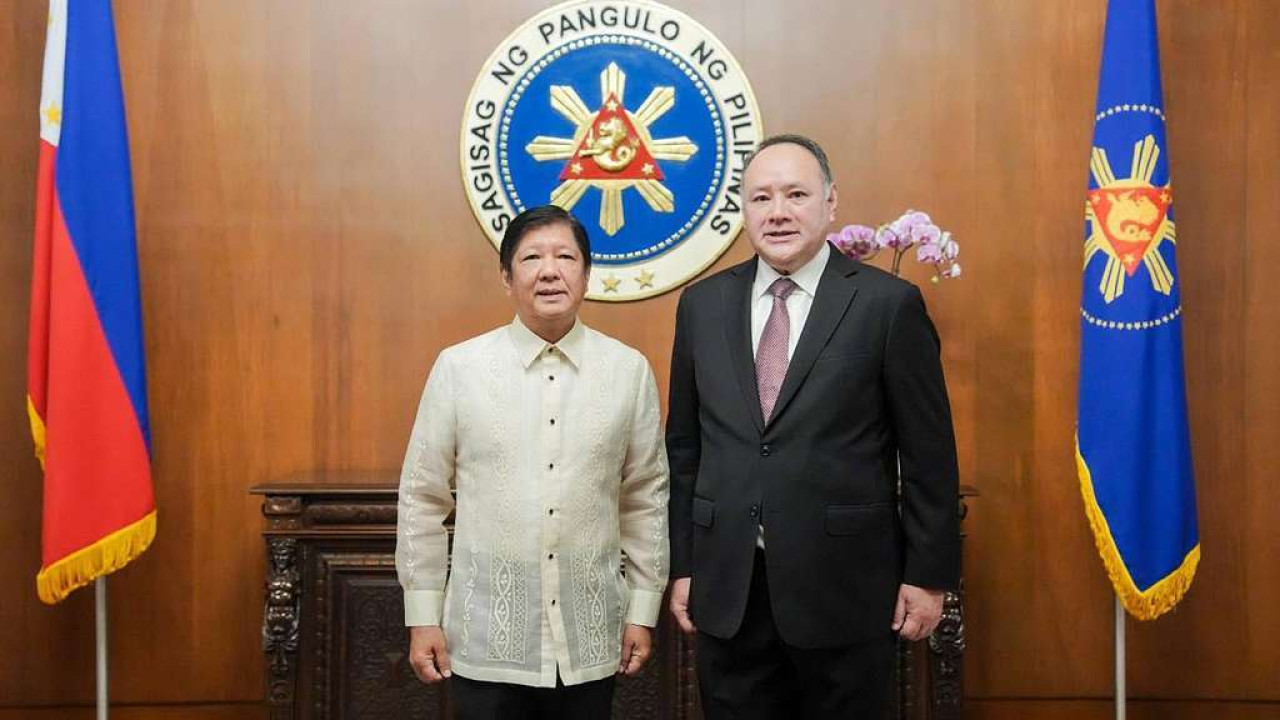
China has formally imposed sanctions on Philippine Defense Secretary Gilberto Teodoro, barring him, his wife, and his children from entering mainland China, Hong Kong, and Macau.
The measures appear to be a response to Teodoro's outspoken criticism of China's repeated incursions into the Philippines' Exclusive Economic Zone. Speaking at the Shangri La Dialogue in Singapore on May 31, 2026, Teodoro stressed that incursions in both the East Sea and the South China Sea are a daily reality for the Philippines and underscored the country's determination to protect its territory.
The Philippine government has condemned the sanctions as an act of political intimidation. On June 12, 2026, Foreign Affairs Secretary Maria Theresa Lazaro said Manila would seek discussions with Chinese authorities on the issue. While acknowledging China's sovereign right to impose sanctions, she maintained that the measures are unjustified and reiterated the Philippines' preference for diplomacy and dialogue.
The Shangri-La Controversy
During the conference, Teodoro defended the expansion of the annual Balikatan military exercises involving the Philippines, the United States, and other partner nations, arguing that they are essential for strengthening the country's resilience and deterrence capabilities. He also blamed much of the region's instability on what he described as China's expansionist policies. Referring to Beijing's controversial nine-dash line, Teodoro argued that China seeks to place most, if not all, of the West Philippine Sea under its control, a claim that Manila firmly rejects.
The remarks further intensified tensions between Manila and Beijing, but they also highlighted a deeper strategic shift underway in Southeast Asia. Responding to US Defense Secretary Pete Hegseth's call for regional states to raise defense spending to 3.5% of GDP, Teodoro argued that burden-sharing should extend beyond military budgets to include technology transfers, expanded defense access agreements, intelligence cooperation, and stronger industrial partnerships.
This position reflects a growing consensus among many Southeast Asian governments. While most continue to avoid formal bloc politics, concerns over China's maritime activities have increased support for a sustained US security presence in the region. ASEAN defense ministers broadly acknowledged this reality during their 2025 meeting, viewing American engagement as an important contributor to regional stability.
All in all, the Shangri-La Dialogue revealed more than just another diplomatic clash between Manila and Beijing. It demonstrated how China's actions are increasingly pushing regional states to deepen security cooperation with external partners, even as they seek to preserve strategic autonomy and avoid direct confrontation.
The Philippines is Expanding Options, Not Choosing Sides
Although security ties with the United States have deepened significantly, Manila is not pursuing a rigid bloc-based foreign policy. President Ferdinand Marcos Jr.'s June visit to Russia, where he met President Vladimir Putin to discuss food and energy cooperation, illustrates the Philippines' continued effort to maintain relationships beyond its traditional allies.
This reflects a broader Southeast Asian approach. Rather than viewing great-power competition as a choice between rival camps, many governments are seeking to extract economic, technological, and diplomatic benefits from multiple partners while preserving their own strategic autonomy.
For the Philippines, however, security and economics are increasingly moving along separate tracks. China's actions in the South China Sea have made the United States and its allies indispensable security partners, but Manila still sees value in maintaining ties with other powers where interests overlap.
The result is not a classic balancing act between Washington and its rivals. Instead, the Philippines is pursuing a strategy of selective alignment, relying on the United States for deterrence while widening its network of economic and diplomatic relationships. In an era of intensifying great-power rivalry, Manila's goal is not to avoid taking sides entirely, but to avoid becoming overly dependent on any single partner.
Loading comments...