




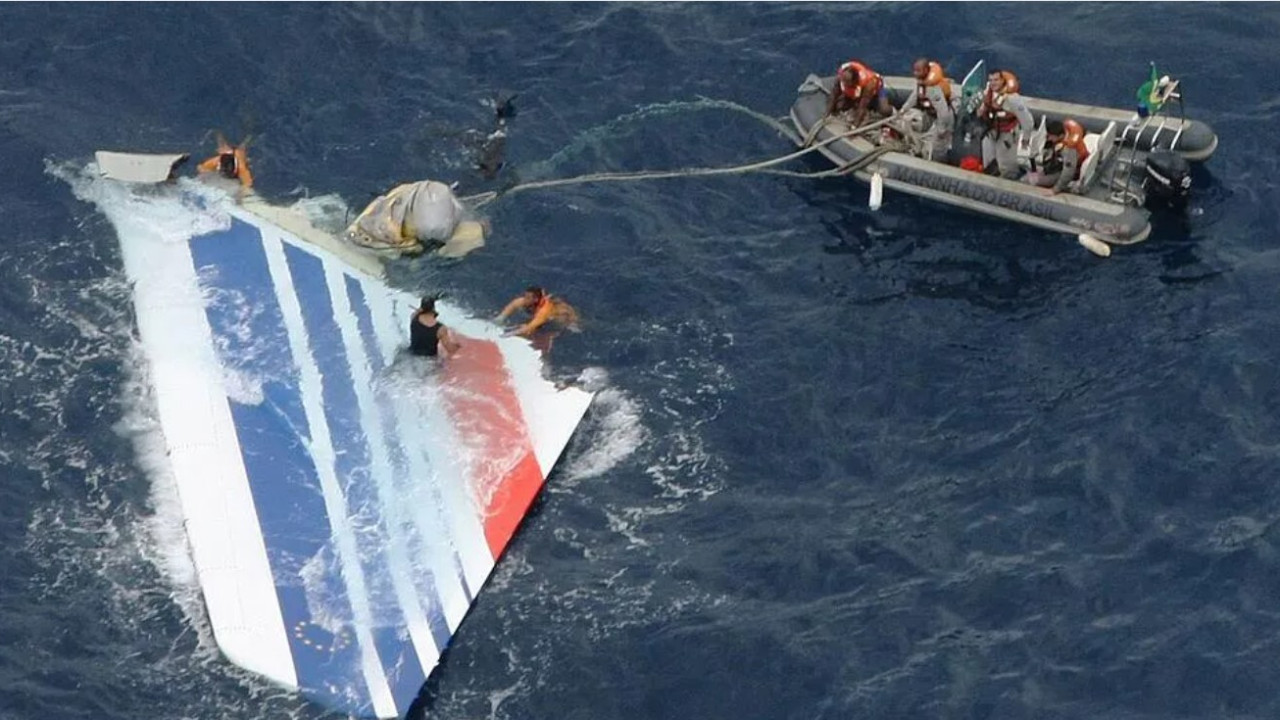
Seventeen years after Air France Flight 447 plunged into the Atlantic and killed 228 people, two corporate giants have finally been branded responsible for one of aviation’s most haunting disasters.
A Paris appeals court has convicted Air France and Airbus of corporate manslaughter, overturning an earlier acquittal and rejecting the idea that two dead pilots should carry the blame alone. The ruling turns a long fight by victims’ families into a rare moment of corporate accountability in a crash that changed how the world trains pilots.
Corporate Giants Held Accountable After 17 Years
Flight 447, an Airbus A330, was flying from Rio de Janeiro to Paris in 2009 when it hit trouble over the Atlantic during a stormy night. Faulty speed probes, known as pitot tubes, froze and gave bad readings. The autopilot disconnected, leaving the pilots to try to fly a jet they did not fully understand.
For years, Air France and Airbus argued that the pilots made fatal errors. But in 2026, the court took a different view.
Judges ruled that the airline and the aircraft maker were “solely and entirely responsible” for the crash. Each company was fined about US $262,000, the maximum penalty for corporate manslaughter. Although the sum is small compared to the size of the companies, it is hugely symbolic.
Immediately after the verdict, Air France and Airbus said they would appeal to France’s highest court, meaning the case could drag on for two or three more years. But the stain on their reputations is already there.
Families who spent years fighting the companies welcomed the verdict. For them, the decision was not about money. It was about ending the attempt to bury corporate failure beneath the bodies of the crew.
The Pilots Were Not the Whole Story
The final four minutes of Flight 447 became one of the most studied cockpit failures in modern aviation. The two first officers, David Robert and Pierre-Cédric Bonin, were on the flight deck when the aircraft’s speed readings failed and the autopilot shut off. Captain Marc Dubois returned from a scheduled rest but was too late to save the jet.
Investigators later found that the pilots failed to grasp that the aircraft had entered a high-altitude stall. They pulled the nose up, lost lift, ignored alarms, and at times gave conflicting commands through the aircraft’s electronic controls.
Those facts were not erased by the court. But the judges refused to let them be the whole story.
Instead, the judges found that Air France had failed to properly train pilots for high-altitude upsets like the one that doomed Flight 447. Airbus was found to have underestimated known problems with Thales-made pitot tubes and failed to warn airlines strongly enough about the danger. Although the pilots made mistakes, Air France and Airbus helped create a dangerous trap.
The disaster later forced major changes in pilot training. Airlines have since put more focus on manual flying, high-altitude stalls, cockpit psychology, and the danger of relying too heavily on automation. In plain terms, the crash exposed a brutal weakness in modern aviation: pilots are flying more advanced aircraft, but some are losing the old manual skills needed when machines suddenly stopped helping.
Families Fought the Blame Game
The families of the 216 passengers and 12 crew members sat through years of legal setbacks before the ruling. In 2023, a lower court acquitted both companies after prosecutors had called for the charges to be dropped.
That was a crushing moment for relatives who believed Air France and Airbus were hiding behind the dead. New analysis and testimony later changed the direction of the case, and prosecutors reversed their position.
The appeals court has now given them something they had waited nearly two decades to hear. The crash was not just a tragedy of human confusion. It was also a corporate failure.
The MH370 Shadow
In the Air France case, the wreckage was eventually found. The flight recorders were recovered after a two-year search. The final minutes were reconstructed. The legal case moved slowly, painfully, and imperfectly, but it moved.
The MH370 case is different. Malaysia Airlines Flight 370 vanished in 2014, and its disappearance remains one of the most disturbing mysteries in aviation history. Families have lived for years with theories, fragments, searches, false hope, and no full account of what happened to the people they loved.
That is why the Air France verdict carries an echo beyond France. It shows that aviation accountability can arrive painfully late, even after powerful companies fight hard to avoid it. But it also shows what MH370 families still do not have: a crash site, a full chain of evidence, a courtroom reckoning, and a final story that can be tested against the facts.
Flight 447 has not reached the end of its legal road. Air France and Airbus are appealing, and the saga may continue for years. But after 17 years, a court has said clearly that the blame cannot be left with the dead.

Loading comments...