




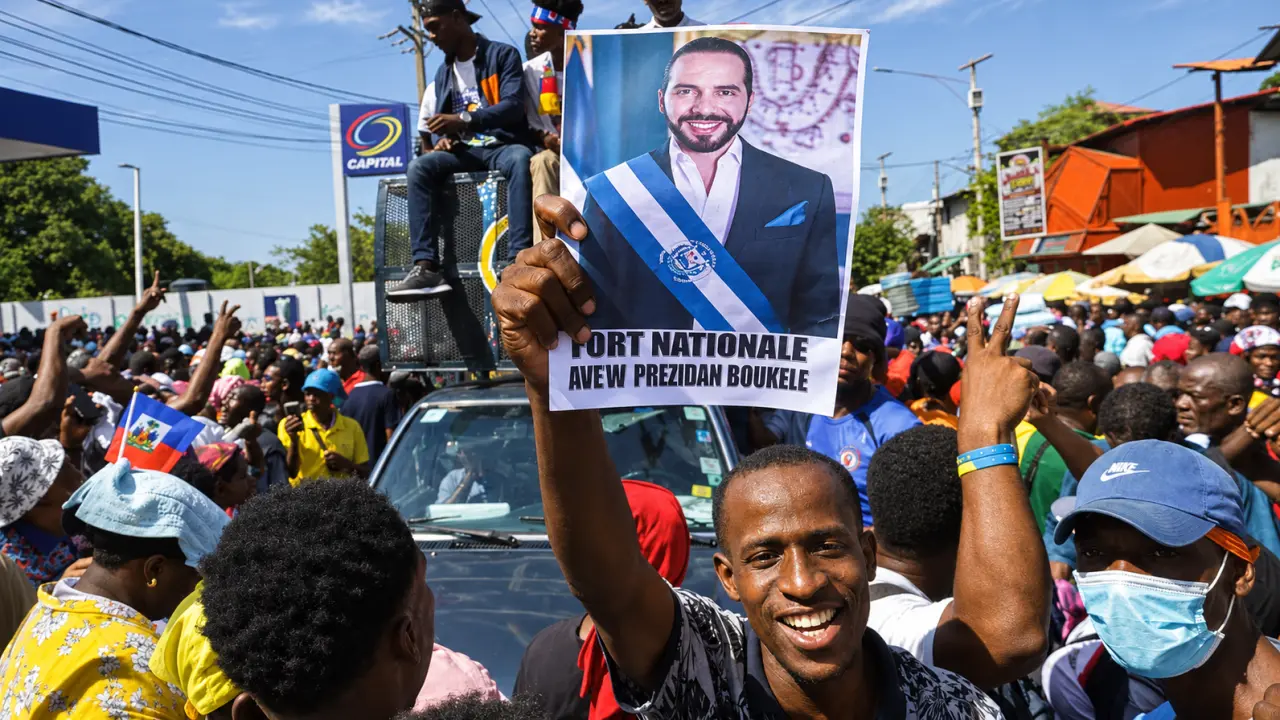
On October 18, four Salvadoran Air Force technicians disappeared in an ambush outside Port-au-Prince. They belonged to a unit that carried out medical evacuations for the UN-authorized Gang Suppression Force (GSF). Few details have emerged about what happened to them. Within days, President Nayib Bukele announced a rescue mission. More than a month later, all four are still missing. The troops Bukele sent to bring them home are now fighting Haiti’s gangs.
The first 1,300 Salvadoran troops arrived on October 27. The next day, Bukele spoke with Haitian Prime Minister Alix Didier Fils-Aimé and announced that the deployment would total more than 2,000 troops. What Fils-Aimé had authorized before the first troops landed remains unclear.
On November 17, Haiti formally approved a bilateral cooperation agreement with El Salvador. Its terms remain confidential. For Salvadorans, the stated objective is to bring the four men home. In Haiti, the scale of the deployment and the intensity of the fighting point to a longer campaign. Its ultimate purpose and its implications for the region remain unclear.
Haitians had waited years for international missions to deliver the troops and funding they had promised. That history helps explain why some residents took to the streets to ask the Salvadorans to stay.
How Bukele Is Promoting His Security Model in Haiti
Escalating gang violence prompted the UN Security Council to authorize a Kenya-led mission in 2023 to help Haiti’s police. It arrived short of staff and funds.
In 2025, the council authorized its replacement, the GSF. By mid-November 2026, the force had about 2,000 personnel in Haiti, including 200 from El Salvador, against an authorized ceiling of 5,550. The troops Bukele sent after the abduction operate under Salvadoran command, outside the GSF.
US President Donald Trump told Bukele to do whatever he needed to do. US Secretary of State Marco Rubio called for deconfliction and urged the forces operating in Haiti to coordinate through the GSF. He also ruled out sending American troops.
Bukele was promoting his security model in Haiti long before the four airmen disappeared. In March 2024, Bukele wrote on X that he could “fix” Haiti’s crisis if the Security Council adopted a resolution, Haiti consented, and the operation’s costs were covered.
The deployment now gives him a chance to prove it and to present himself as a regional leader on security. Oversight is weak, and few reporters can independently establish who his troops have killed. If Bukele announces the death of a gang leader, the public may have little beyond his account to go on. That gives him considerable room to set his own terms for success.
Across the Americas, the deployment drew little public debate over the precedent it set. For governments aligned with the United States, Trump’s backing may help explain the muted response. Fatigue with Haiti’s crisis may also play a part.
Why Haiti Will Be Harder for Bukele
El Salvador recorded nearly 97% fewer homicides in 2025 than in 2019, according to police figures. Under the state of emergency imposed in 2022, Salvadoran authorities arrested more than 90,000 people on suspicion of gang membership or ties to gangs. Human Rights Watch documented arbitrary arrests, prolonged pretrial detention, and mass trials that limited defendants’ ability to defend themselves.
Erik Prince, founder of the private security firm Vectus Global, has praised Bukele’s crackdown on gangs. Before Bukele sent troops to Haiti, Vectus had already hired Salvadoran mercenaries for anti-gang operations there. Human Rights Watch had also documented civilian deaths in drone strikes in Port-au-Prince.
In Haiti, Bukele faces gangs that, in some cases, operate much like militias. They hold territory, have their own chains of command, and can be better armed than the Haitian police.
For decades, Haitian politicians and business owners financed armed groups to intimidate rivals and protect their interests. Extortion, kidnapping, and drug trafficking eventually gave the gangs enough income to act independently of their patrons. The assassination of President Jovenel Moïse in 2021 left a power vacuum that gave them room to expand.
In 2024, rival gangs formed a coalition called Viv Ansanm. While then-Prime Minister Ariel Henry was abroad, they attacked police stations, stormed prisons, and forced the capital’s airport to close.
By late September 2025, more than 1.4 million people had fled their homes because of gang violence. Half were children. Between January 2022 and the end of June 2026, gang violence killed 21,000 people. Gangs now control about 80% of Port-au-Prince, including access to ports and routes to the Dominican border.
How Could Bukele’s Haiti Mission Play Out?
In the coming months, foreign troops will likely help Haitian police regain control of some areas. But even if they drive a gang out of a neighborhood, the network that kept it armed and protected could survive. The businessman who supplied its weapons may still be in business, and the police officer who warned its leaders may still be on duty. After the last UN peacekeeping mission ended, some gangs regained strength.
Better security could make it easier to hold elections in those areas in July 2027. But wherever gangs can still threaten people who run for office or turn out to vote, their political backers could help allies win seats in Parliament and preserve their influence.
A longer campaign could draw troops deeper into crowded neighborhoods where gangs use residents as human shields. If troops carry out mass arrests, Haiti’s weak courts may offer detainees little protection against abuse. In the worst case, the crackdown could lead to mass killings.
Bukele can claim a political win the day of a raid by sharing footage of his troops in action. For a Haitian resident who identifies a gang member, the real danger may come after the cameras and soldiers leave. That resident still has to live in the neighborhood and could face reprisals if the gang returns. Protecting residents means choosing areas Haitian police can hold, committing officers to stay after the raid, and giving people who want to leave the gangs a safe way out.
Children are particularly exposed. UNICEF estimates that 30-50% of the people who belong to gangs or work with them are children. Gangs forced some to join. For others living in extreme poverty, the gangs offered their only steady income. Helping children leave safely could protect them and give their families a reason to support efforts to dismantle the gangs.
The release of the four airmen would give Bukele a result to take into his February 2027 reelection campaign. He has already shared footage of thousands of Haitians chanting his name. The longer the search lasts, the more pressure he faces to show Salvadorans what the deployment is achieving, what it costs, and why their troops should stay.
Salvadoran troops could help Haitian police reclaim parts of the capital, and the GSF could remain after they leave. But military force alone cannot break the ties between gangs and political power.
The question is whether the international community will help Haitians hold elections in which candidates with no ties to the gangs or their backers can run safely. Those who win must be able to govern without intimidation and hold the people who finance the gangs to account. Bukele could claim a political victory at home even if Haitians end up worse off than they were when his troops arrived.



Loading comments...