




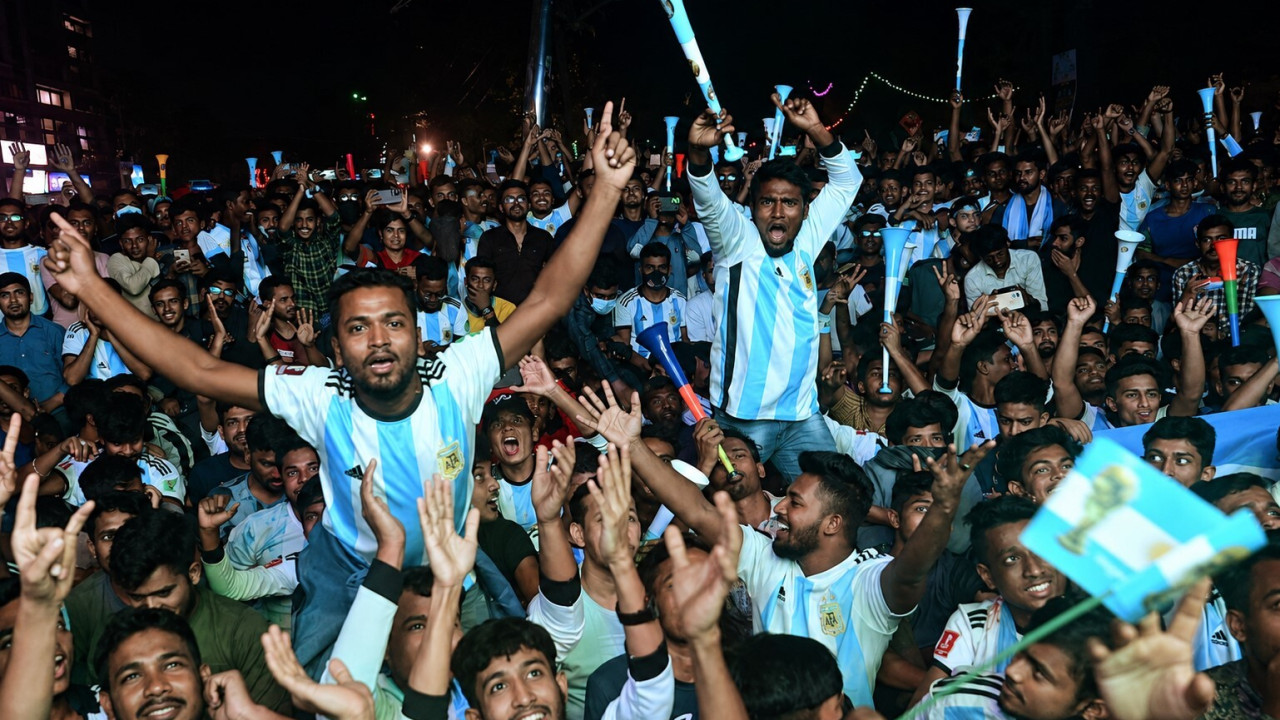
Argentina is playing more than 17,000 kilometers from Bangladesh, yet millions of fans watch Argentina as if the blue-and-white shirt represents them too. Across the country, streets fill with flags, murals of Messi and Diego Maradona cover walls, and families gather through the night for matches that begin in the early morning.
The scale of that support is striking. Bangladeshi writer and sports commentator Rajib Hasan has estimated that more than 60% of the country’s 120 million World Cup viewers support Argentina. That would mean there are around 72 million Argentina fans in Bangladesh, far more than Argentina’s own population of roughly 46 million.
Bangladesh’s own absence from the World Cup has helped reinforce the trend. The national team has never qualified for the tournament. With no home side to support on football’s biggest stage, many fans adopt foreign teams.
Bangladesh's Argentina passion has surged again during the 2026 FIFA World Cup, bringing back a question that also came up in Qatar four years ago: why does a South Asian country with no World Cup history of its own love Argentina so much?
As it turns out, the answer is not only about Messi, Maradona, and football, but also about collective memory and colonial history.
Maradona Gave Bangladesh A Symbolic Revenge
The root of Bangladesh's obsession goes back to 1986. That year, Argentina beat England by a score of 2-1 in the World Cup quarterfinals in Mexico. Maradona scored the two goals, both of which became iconic. One became known as the “Hand of God,” while the other was termed the "Goal of the Century."
Bangladesh did not see only a football match. Instead, it saw a country that had also experienced the brutality of British colonialism humiliating England on the biggest stage in sport. The image landed with unusual force because of how deep Bangladesh's historical wound is.
Bangladesh did not exist as an independent state during British rule. It was part of Bengal under the British Empire, then became East Pakistan after partition, and finally won independence in 1971.
But the memory of colonial rule remained strong, particularly around the Bengal famine of 1943. The catastrophe killed around three million people, and many Bangladeshis still associate it with British wartime decisions that stripped coastal Bengal of rice, boats, and relief at the worst possible moment.
That is why Maradona mattered beyond football. He looked like rebellion. He looked like the weak hitting back at the powerful.
For many Bangladeshis, Argentina's victory over England felt like emotional payback. It gave a whole generation a football story they could pass down at home.
Messi Created A New Mass Movement
For older fans, Maradona was the spark. For younger fans, Messi has become the new icon. Parents who grew up hearing about 1986 now watch Messi with their children. Maradona is a legend of the past and Messi is a legend of the present, but together they form one continuous emotional line.
This is also why the passion survived long after Maradona stopped playing. It was never built only on one player and instead became a type of social inheritance. A child could grow up in Dhaka, Chittagong, or Sylhet and learn that Argentina was “our” team before fully understanding why.
What Bangladesh Reveals About Asian Football
Across South and Southeast Asia, millions of fans passionately support foreign national teams because their own countries rarely appear on football’s biggest stage. But these loyalties are rarely random. They are shaped by history, media exposure, family traditions, migration, class, and the search for a story people feel connected to.
That is what makes Bangladesh’s attachment to Argentina so remarkable. It is not simply admiration for successful players or attractive football. It is the acknowledgement of a shared history. Through Maradona and later Messi, Argentina became associated with qualities that resonated far beyond South America: resilience, defiance, underdog triumph, and sporting greatness.
For Bangladesh, supporting Argentina gives millions of fans a team to celebrate, defend, and emotionally invest in on the sport’s biggest stage. That is why Argentina’s popularity in Bangladesh has endured for decades, becoming part of a cultural tradition passed from one generation to the next.
The world may still find that unusual. Bangladesh does not.


Loading comments...