




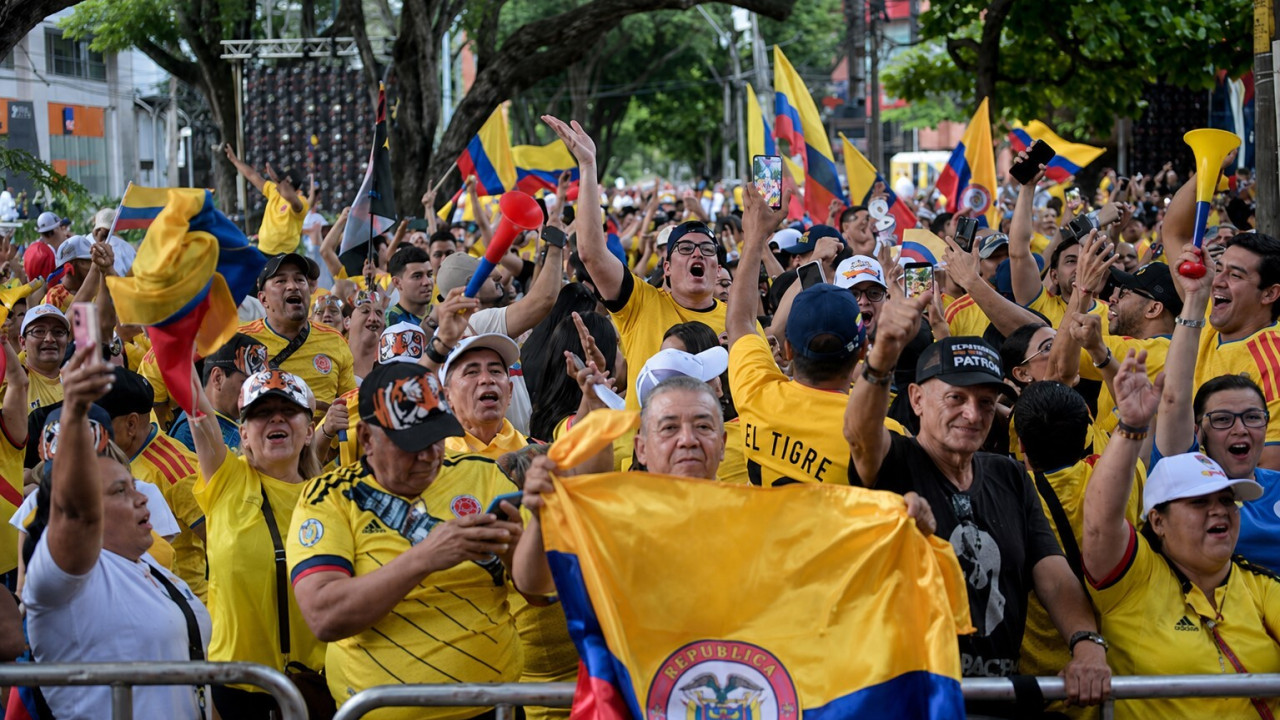
Colombia appears to be politically splintering. Far-right candidate Abelardo de la Espriella won Colombia’s presidential runoff by less than 1%. Preliminary results gave him about 49.6% of the vote, against nearly 48.7% for his left-wing rival, Senator Iván Cepeda.
The vote closes a historic political chapter. Outgoing President Gustavo Petro led Colombia’s first modern left-wing government, after coming to power in 2022 promising to reduce violence through negotiations, expand social protections, and break with decades of conservative security politics. De la Espriella’s victory is therefore not only a right-wing win, but a backlash against a left-wing experiment that many voters came to see as unable to deliver the change it promised.
With the election over, De la Espriella is set to take office on August 7. He will inherit a country that is deeply politically divided, squeezed by a severe fiscal crisis, facing a health system on the brink of collapse, and confronting one of its worst surges in armed violence in two decades.
An Election Marred by Violence
The campaign was also shaped by an event that revived Colombia’s darkest memories of political violence: the June 7, 2025, attack on Miguel Uribe Turbay, a conservative senator and presidential hopeful. Uribe died two months later from the wounds he suffered during the campaign event in Bogotá.
Uribe's death pushed security to the center of the race. It also reinforced a growing perception that Colombia was entering a dangerous new phase, with armed groups expanding their influence and the state struggling to maintain control in some parts of the country.
De la Espriella quickly moved to capitalize on the incident. He promised to restore order, declare open war on drug trafficking and organized crime, and abandon the negotiation-based approach that defined much of Petro's presidency. For many voters, that message offered a decisive response to worsening insecurity. For critics, however, it raised concerns that Colombia could return to the heavy-handed security policies of the past, when the fight against insurgencies was accompanied by widespread human rights abuses, including extrajudicial killings.
Failed Peace Promises Led to Political Backlash
Petro, constitutionally barred from seeking reelection, came to power in 2022 promising to transform the country. He pushed through some social and economic reforms, but many of his flagship initiatives were slowed, diluted, or blocked by opposition lawmakers, who argued that his agenda would expand the state too quickly, strain public finances, and disrupt key sectors such as healthcare and labor.
Petro’s Total Peace program, designed to negotiate with the country’s many armed groups, also exposed the limits of his approach. Colombia’s conflict had become more fragmented since the 2016 FARC peace deal, with smaller armed factions competing for territory, drug routes, and illegal economies. Ceasefires with several groups also proved difficult to enforce, and some organizations used the talks to buy time in order to expand, rearm, and strengthen their territorial control.
In his final year as president, Petro also pushed for constitutional change after Congress blocked key parts of his reform agenda, especially on labor, health care, and the role of the state. He framed the move as a way to let voters decide reforms that Congress had stalled. His opponents, however, saw it as an attempt to bypass Congress and reshape Colombia’s political system from the left.
Adding to the overall damage were corruption scandals, management failures, and Petro’s own taste for political controversy and grandiose rhetoric on social media.
The Clients Behind the Anti-Crime Candidate
President-elect De la Espriella built his name as a criminal lawyer for powerful but controversial figures. Critics and political rivals have questioned his professional links to clients associated with paramilitary networks, corruption cases, and circles close to the Venezuelan regime.
As a lawyer, he represented Álex Saab, a Colombian-Venezuelan businessman accused of acting as a frontman for Nicolás Maduro. De la Espriella insisted he cut ties with Saab in 2021, but the relationship kept haunting his campaign, especially after media reports about payments linked to companies connected to Saab.
That past fed one of the biggest contradictions of his candidacy. De la Espriella presented himself as the man who would clean up the state and confront crime, yet his legal career was tied to some of the most controversial names in Colombia and Venezuela.
De la Espriella's Vision for Colombia
De la Espriella’s agenda points to a sharp break from the Petro years. On security, he has proposed destroying about 330,000 hectares of coca crops through aerial fumigation and manual eradication. He has also promised to go on the offensive against guerrillas, dissident factions, and criminal organizations.
On the economy, he says Colombia can reach annual growth of 7%, inspired by the models of South Korea and Singapore. He also wants to cut the size of the state, reduce the tax burden, eliminate red tape, and scrap Colombia’s financial transaction tax.
On foreign policy, the shift would be just as dramatic. De la Espriella wants to align Colombia with Donald Trump, restore relations with Israel, and break ties with the Venezuelan regime until democratic elections are held.
Colombia Joins the Global Turn Toward Hardline Politics
Growing distrust of traditional politics has created an opening for leaders like De la Espriella. Like Javier Milei in Argentina, Daniel Noboa in Ecuador, and Nayib Bukele in El Salvador, De la Espriella has based his appeal on the idea that strong, decisive leadership can achieve what consensus-based politics has not.
This debate is not limited to Latin America. Democracies in the Global South face many of the same pressures. Whether the issue is economic stagnation, irregular migration, or corruption, voters often become more willing to support leaders who promise heavy-handed tactics, even if that means testing institutional checks and balances.
This is why Colombia’s election should not be viewed as an isolated Latin American phenomenon. It is part of a broader trend in which voters, frustrated by the lack of progress and relief, become more willing to back leaders with inflammatory rhetoric. Rather than appealing to national unity, these leaders appeal to fear and downplay the importance of political dialogue. Combined with such a close result, which showed that the Columbian electorate is split almost down the middle, that dynamic could become a prelude to serious social conflict.
In Colombia’s case, the attempt to end a long-standing and violent conflict through more violence could open a new era of internal confrontation in a country that has yet to heal its old wounds.

Loading comments...