




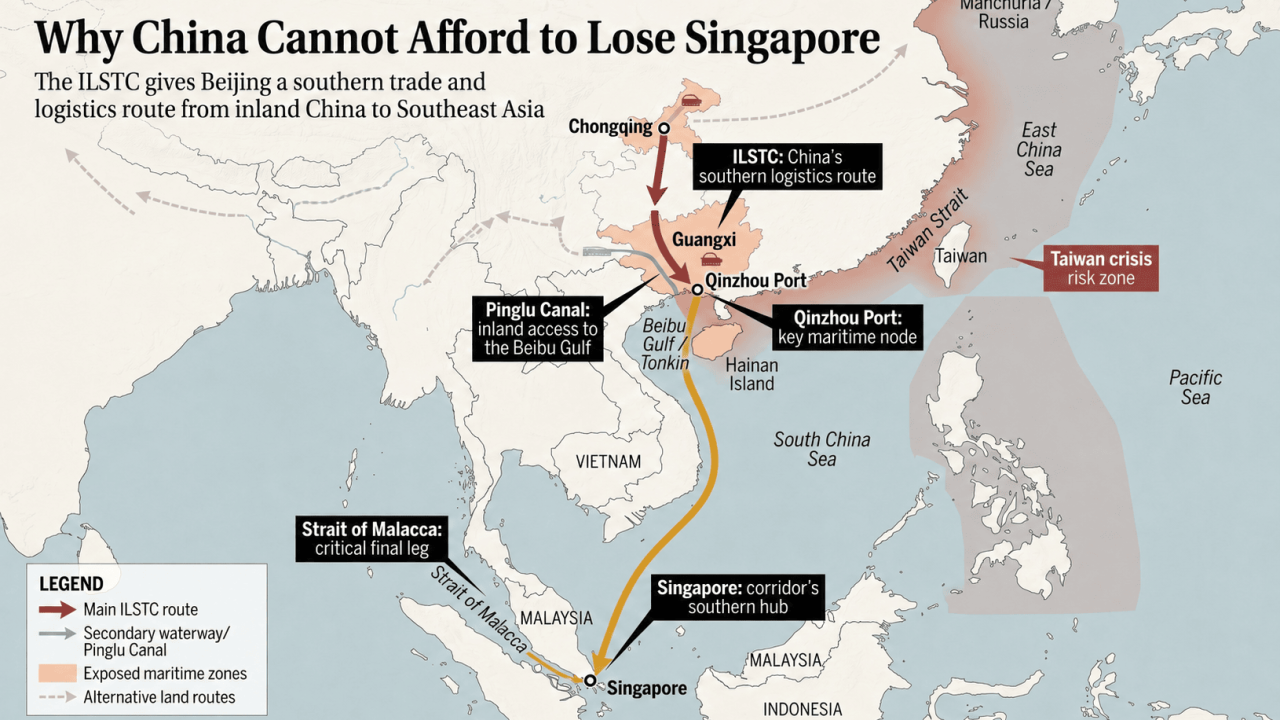
For Beijing, Singapore is becoming more than a diplomatic partner or a commercial hub. It is increasingly tied to one of China’s most important alternative logistics routes: the New International Land-Sea Trade Corridor (ILSTC), a network linking western China to Southeast Asia by rail, road, inland waterways, and sea routes.
The corridor runs from Chongqing, the anchor of China’s inland industrial base, through Guangxi to Qinzhou Port on the Beibu Gulf, then onward to Singapore, giving Chinese goods a southern route into Southeast Asia and global markets.
That route could become far more important if a crisis around Taiwan disrupts maritime traffic through the East China Sea, the South China Sea, or the Taiwan Strait. This is why the ILSTC is more than a Chinese infrastructure project. It is a logistics architecture Singapore helped design, and one Beijing has every reason to keep open.
Taiwan Is the Problem Beijing Cannot Ignore
The strategic value of the ILSTC becomes clearer when viewed through the Taiwan Strait.
A blockade or armed conflict around Taiwan would hit China’s economy directly. In 2022, more than one-fifth of global maritime trade passed through or near the Taiwan Strait, which China also relies on for energy, minerals, manufactured goods, and internal coastal shipping.
In a Taiwan crisis, China’s maritime routes through the East China Sea and the South China Sea would become exposed or contested.
Beijing has alternatives, but none that can replace maritime transport at scale. The Eurasian land bridge from Chongqing through Central Asia to Europe is useful, as are the rail links through Manchuria into Russia. But for bulk trade, rail remains slower, costlier, and more dependent on difficult political geography.
This is what gives the southern route its strategic weight. The ILSTC allows China to push inland production toward Guangxi, the Beibu Gulf, and Southeast Asia, instead of relying exclusively on exposed coastal ports near Taiwan, Japan, and the wider western Pacific.
China’s Southern Route Takes Shape
The corridor begins in Chongqing, one of China’s most important inland industrial cities.
Chongqing is a major center for laptops, electric vehicles, automobiles, and advanced manufacturing. Its industrial base is not concentrated on China’s vulnerable eastern seaboard. It sits deep inland. In a crisis, that geography becomes an advantage.
The ILSTC allows goods from western China to move south toward Qinzhou Port in Guangxi. From there, shipments can enter the Beibu Gulf and continue toward Singapore, ASEAN, and global markets.
The Pinglu Canal adds another layer. The 134-kilometer waterway will connect Guangxi’s inland river system more directly to the Beibu Gulf near Qinzhou. Once fully operational, it is expected to shorten routes, reduce logistics costs, and give western provinces more direct maritime access to ASEAN markets.
The Beibu Gulf is also not an open, unprotected sea. To the east lies Hainan Island, home to China’s major naval facilities in the South China Sea. That does not make the corridor invulnerable, but it changes the risk calculation. Trying to disrupt traffic in the Beibu Gulf would carry a different level of risk than pressuring vessels in the open South China Sea or the Taiwan Strait.
Beijing also understands that this route depends on keeping Vietnam from becoming a hostile chokepoint. The South China Sea remains deeply contested, but the Gulf of Tonkin is different. China and Vietnam have a defined maritime boundary there, agreed in 2000 and in effect since 2004. Their navies continue to conduct joint patrols in the area.
That does not erase mistrust between Beijing and Hanoi. But it shows that China treats the Beibu Gulf as a space to be managed bilaterally, rather than allowed to become another maritime flashpoint.
The Malacca Paradox
The final stretch of the corridor runs through Southeast Asian waters. That makes ASEAN coastal states decisive.
Here lies one of the great ironies of China’s maritime strategy. In the South China Sea, Beijing has often challenged the very legal order that the Philippines, other ASEAN states, and Washington invoke against it. The 2016 arbitral award, issued after Manila brought its case against China, rejected most of Beijing’s expansive claims under UNCLOS. But in the Strait of Malacca, China benefits from the same legal framework it dislikes elsewhere.
Singapore, Malaysia, and Indonesia have a shared interest in keeping Malacca open. Singapore’s foreign minister, Vivian Balakrishnan, has stressed that the three littoral states are strategically aligned on this point and operate on the basis of UNCLOS, including transit passage.
For Beijing, that is useful. A Malacca Strait governed by UNCLOS, kept open by ASEAN coastal states, and not controlled by Washington is exactly what China needs for the southern leg of the ILSTC to remain viable.
Beijing would never frame it this way publicly. But in practice, China needs ASEAN maritime law when that law protects its access.
The United States faces its own constraint. Washington cannot easily threaten the Strait of Malacca without undermining the same maritime legal order it uses to challenge China in the South China Sea. That gives Singapore, Malaysia, and Indonesia an important stabilizing role.
Singapore’s Double Leverage
Singapore’s value comes from being useful to both sides without being owned by either. To Washington, Singapore is one of the most valuable security partners in Southeast Asia. Changi Naval Base hosts visiting US aircraft carriers and submarines, while US maritime patrol operations from Singapore strengthen surveillance capacity in and around the South China Sea. Singapore is not a US treaty ally, but in practical terms it often matters more than some formal allies.
To Beijing, Singapore is useful for a different reason. It is not simply a commercial stop at the end of the ILSTC. It is the corridor’s southern hub, its gateway to Southeast Asia, and a country that helped shape the logistics architecture China may need in a Taiwan crisis.
That is what gives Singapore its double leverage. For China, pushing Singapore fully into the US camp would risk weakening a southern route Beijing may need if its eastern maritime routes are disrupted. For the US, losing Singapore to China would weaken one of its most important operational footholds in Southeast Asia.
Singapore’s goal is survival through indispensability. The ILSTC shows how that works in practice. China gets a southern corridor. ASEAN gets trade and connectivity. Singapore gets something more valuable: a position both superpowers need, but neither can easily own.



Loading comments...