




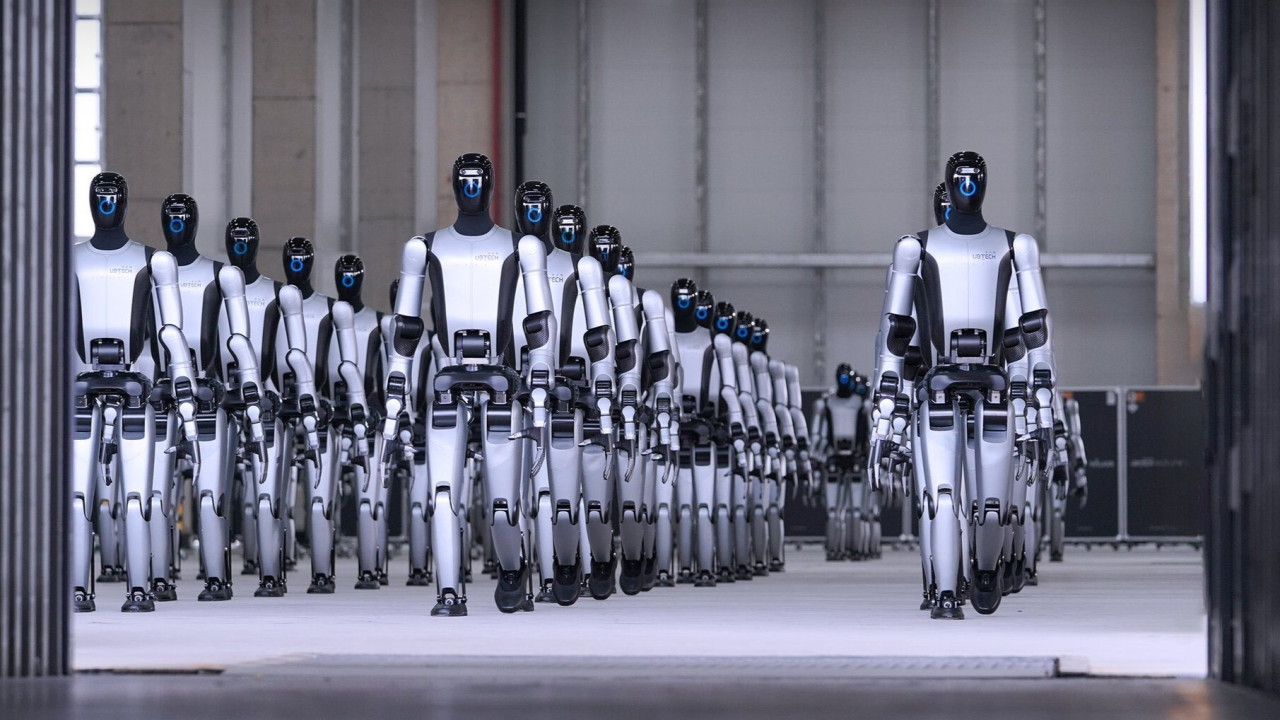
China is flooding global markets with low-cost robots. The concern is not just that these machines are becoming cheaper, smarter, and more widespread. It is that they are increasingly mobile, networked, and packed with sensors capable of seeing, mapping, moving, transmitting data, and interacting with the physical world.
As robots become more connected and autonomous, some security analysts warn that foreign-made systems operating inside sensitive infrastructure could create new vulnerabilities during periods of geopolitical tension.
China is using a strategy similar to the one that helped it dominate the commercial drone market: state-backed scale, aggressive pricing, rapid deployment, and market capture before rivals can respond. If Chinese-made robots become deeply embedded in global infrastructure, the risks could extend to airports, transport hubs, military facilities, energy systems, factories, and cities around the world.
Why Security Experts Are Concerned About Chinese Robotics
Industry experts have warned that handing over the robotics market to China would be like installing a “Trojan horse” inside critical infrastructure.
Modern robots are "cyber-physical" systems. This means they operate in both the physical and digital worlds by combining sensors, software, communications networks, autonomous movement, and remote management.
This makes them different from ordinary connected devices. A hacked computer may leak data. A hacked robot inside a sensitive facility could spy on operations, map restricted spaces, interrupt work, damage equipment, or even create real physical danger.
Chinese companies such as Unitree Robotics operate under laws that can require them to provide data and system access to state intelligence agencies. In a crisis, that could give Beijing leverage over machines already deployed inside foreign infrastructure.
From Factory Floors to Military Experiments
The most disturbing evidence involved Unitree robots appearing in military settings. Videos showed a Unitree quadruped robot fitted with an automatic rifle and used during a Chinese military exercise.
Chinese state media has shown robot dogs deployed alongside armed drones and soldiers in simulated urban combat. In separate university-linked military training, a robot dog capable of launching rockets also appeared.
That blurring of civilian and military use is what makes the spread of Chinese robotics so dangerous. A robot sold as a commercial machine can still help normalize, test, and refine battlefield systems. The same basic platform that walks through a factory can also move through a combat zone.
AI becomes far more consequential once it leaves the screen. Inside robots, drones, autonomous vehicles, and mobile sensors, AI becomes a physical force. It can move through streets, ports, border zones, stations, bases, and power systems.
The Hidden Risk of Mapping and Data Collection
One of the biggest risks is mapping. Robots and advanced sensors can gather detailed spatial data on the places where they operate.
Chinese-made LiDAR sensors, a laser-based technology used to scan spaces and create detailed 3D maps, were found at New York’s JFK Airport and Penn Station. Their presence raised fears that sensitive sites could be mapped in real time.
The broader concern applies anywhere. Once foreign-linked sensors are placed inside major transport hubs or sensitive facilities, they may expose how those sites are built, protected, and used.
Chinese intelligence agencies were also caught using LiDAR sensors to map US military bases in the Philippines. The threat becomes even more serious when those sensors are mounted on mobile robots that can move through spaces while collecting data.
China Is Expanding Faster Than Competitors
Chinese robotics companies are backed by a national strategy designed to drive prices down, scale production up, and deploy Chinese systems faster than foreign competitors can match. While the United States and Europe remain strong in advanced research, China is moving aggressively to dominate manufacturing, deployment, and commercial adoption.
Beijing has announced a national venture fund worth roughly US$140 billion focused on robotics and advanced technologies. Major Chinese cities including Beijing and Shanghai are also operating large robotics investment programs, while state-owned banks continue pouring money into industrial automation and factory expansion.
The strategy mirrors China’s earlier rise in sectors such as solar panels, electric vehicles, batteries, and commercial drones: use scale and pricing advantages to secure market dominance before foreign rivals can fully respond.
If Chinese firms become the default suppliers for robotics infrastructure worldwide, many countries could eventually become dependent on Chinese platforms for the next generation of automation.
A New Geopolitical Technology Race
The debate around Chinese robotics is no longer just about technology or manufacturing. It is increasingly becoming a geopolitical and security issue tied to infrastructure, supply chains, artificial intelligence, and strategic dependency.
Cheap robots may appear attractive for governments and businesses under pressure to modernize quickly. But critics argue that long-term dependence on foreign-controlled robotics systems could create hidden vulnerabilities that only become clear during future political or security crises.
The world is entering a new era where machines that manage warehouses, monitor infrastructure, inspect energy systems, transport goods, and support military logistics may also become instruments of geopolitical influence. If China secures an early lead in that market, the risks will not be limited to one country alone.



Loading comments...